TollFree: 1800-102-3570 hello@greensew.com

Sewage Treatment in Hyderabad

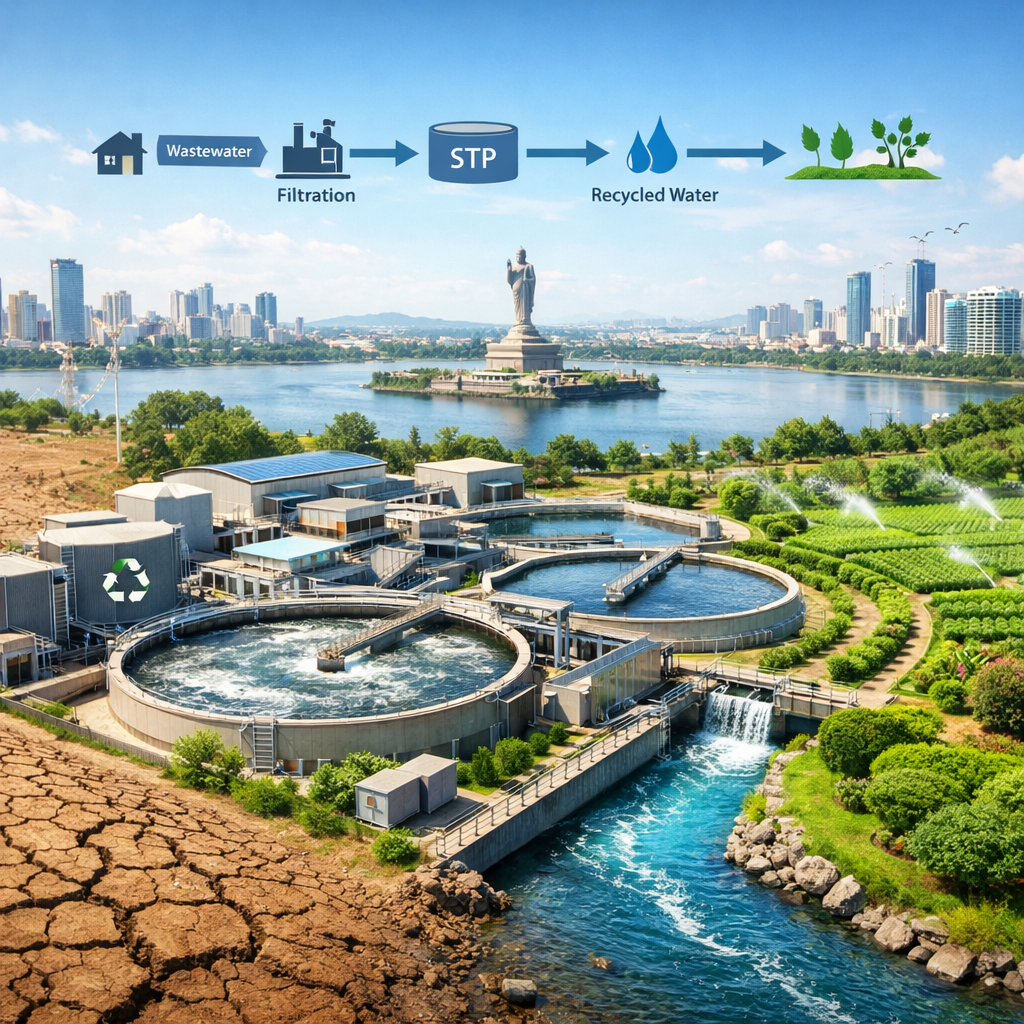
With rapid urban growth in Hyderabad, sewage generation is increasing significantly. Installing efficient Sewage Treatment Plants (STPs) is crucial to manage wastewater, prevent pollution, comply with regulations, and ensure sustainable water reuse for the city’s future.

Why STP is Important in Hyderabad

Water Scarcity & Groundwater Stress – Hyderabad is facing increasing pressure on groundwater and freshwater sources; STPs enable wastewater reuse for flushing, gardening, and industrial applications.

Strict Government RegulationsSTP installation is mandatory for apartments, gated communities, and commercial projects as per Telangana Pollution Control Board (TSPCB) norms.

Lake & River Pollution Control – Untreated sewage pollutes lakes and water bodies like Hussain Sagar; STPs play a crucial role in protecting these ecosystems.

Sustainable Urban Growth – With rapid infrastructure and real estate development, STPs ensure environmentally responsible growth and regulatory compliance.

Cost Savings & Water Reuse – Treated water reduces dependency on tanker supply, helping apartments, IT parks, and industries cut long-term water costs.

blank
blank

Local Regulations – Hyderabad (TGPCB Guidelines)

TGPCB Approval: Projects must obtain Consent to Establish (CTE) and Consent to Operate (CTO) from the Telangana State Pollution Control Board before installing and operating an STP.

Mandatory Rules: STPs are compulsory for apartments, gated communities, commercial complexes, hospitals, hotels, and IT parks as per environmental norms and GHMC/building approval regulations.

Reuse Norms: Treated wastewater should be reused for flushing, gardening, landscaping, and cooling towers, ensuring it meets prescribed quality standards.

Discharge Standards: Treated water must comply with limits such as pH (5.5–9), BOD (10–20 mg/L), TSS (20–30 mg/L), COD (50–100 mg/L), along with controlled fecal coliform levels as per TSPCB norms.

Monitoring: The Telangana State Pollution Control Board conducts regular inspections and monitoring to ensure compliance, with stricter enforcement for non-compliance and environmental violations.
Our STP Solutions

easySTP

easySTP

A compact, plug-and-play sewage treatment plant designed for easy installation, low maintenance, and efficient wastewater treatment.

easySBR

easySBR

A time-based treatment system that processes wastewater in batches, ensuring high-quality output with flexible operation and control.

blank

MBR

An advanced treatment process that uses biofilm carriers to remove organic pollutants efficiently with minimal space and maintenance.

Ideal Applications

STP for Apartment Wastewater Treatment

Apartments

Efficient sewage treatment for high-density residential living with consistent water reuse.
STP for Villas Wastewater Treatment

Villas

Compact and low-maintenance STP solutions tailored for independent homes and gated communities.
Commercial STP Wastewater Treatment System

Commercial

Reliable wastewater management for offices, malls, and business spaces ensuring compliance.
STP for Hotels Wastewater Treatment

Hotels

Hygienic and odor-free treatment systems designed for high water consumption and guest comfort.
Industrial STP Wastewater Treatment System

Industries

Robust and scalable STPs built to handle complex industrial wastewater loads.
blank

Hospitals

Advanced treatment systems ensuring safe disposal of medical wastewater with strict hygiene standards.

Our Presence in Hyderabad

🤝 Channel Partner
Geetha and Gautham

🏢 Company

G & G Water Technologies

📍 Address
 Plot No: 2 ,engineers Colony, L B Nagar, Hyderabad – 500 074

📞 Phone
8106713331

🤝 Channel Partner
Manimaran

🏢 Company

Markserv Engineers

📍 Address
H.No.12-13-645/ B&C, Prajay Nivas Nagarjuna Nagar Colony, Tarnaka, Secunderabad – 500 017. Telangana. India.

📞 Phone
95425 92550

FAQs

1. Is installing an STP mandatory in Hyderabad?

Yes, as per Telangana State Pollution Control Board (TSPCB) norms, STP installation is mandatory for apartments, gated communities, commercial buildings, and large developments based on wastewater generation capacity and local authority approvals.

2. What are the benefits of installing a sewage treatment plant?

STPs help in wastewater recycling, reduce dependency on tanker water, lower operational costs, prevent pollution, and ensure compliance with environmental regulations.

3. Where can treated water from an STP be reused?

Treated water can be reused for flushing, gardening, landscaping, cooling towers, and other non-potable applications, helping conserve fresh water.

4. What is the difference between MBBR and SBR technologies?

MBBR uses biofilm carriers for continuous treatment with low maintenance, while SBR treats wastewater in batches with high efficiency and flexible operation control.