
Sewage Treatment Plants (STP): Process, Types & How They Work
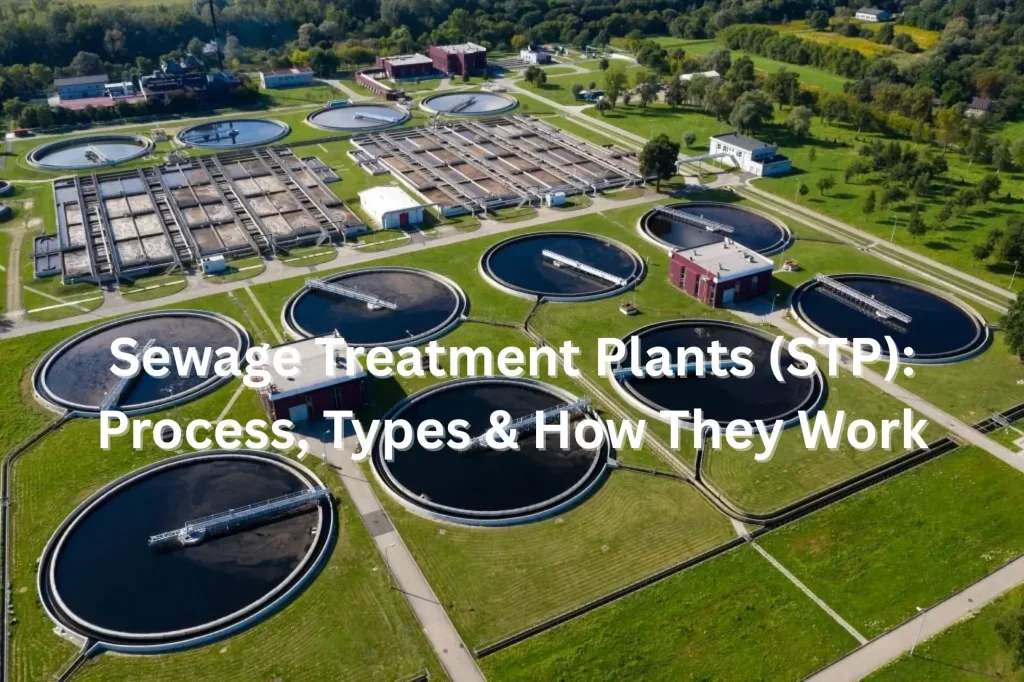
Have you ever thought that the water you use today may have once been someone else’s shower water? This fascinating transformation is possible because ofSewage Treatment Plants (STP) — the silent guardians of public health and environmental sustainability.
STPs are not just municipal infrastructure; they are a critical component ofmodern water management systems for cities, industries, residential complexes, and commercial facilities. They enable wastewater to be safely treated, recycled, and reused — conserving freshwater and protecting natural ecosystems.
This guide explains theSewage Treatment Plant process, explores thedifferent types of STP technologies, and helps you understand how to choose the right system.
What is a Sewage Treatment Plant (STP)?
ASewage Treatment Plant is a facility that collects and treats wastewater from homes, businesses, and industries. Its main purpose is to removephysical, chemical, and biological contaminants, producing treated water that is safe for discharge or reuse.
Without proper treatment:
- Rivers and lakes become polluted
- Oxygen levels in water bodies drop
- Public health risks increase
In simple terms, an STPconverts harmful sewage into reusable water, supporting a circular and sustainable water economy.
Sewage Treatment Plant Process – Step by Step
Modern STPs follow a structured, multi-stage treatment system:
1. Preliminary Treatment
This stage removes large debris and heavy particles:
- Bar screens remove plastics, cloth, wood, etc.
- Grit chambers remove sand and gravel
This protects pumps and downstream equipment.
2. Primary Treatment (Physical)
Wastewater enters sedimentation tanks:
- Heavy solids settle as sludge
- Oils and grease float and are skimmed off
This stage removes a major portion of suspended solids.
3. Secondary Treatment (Biological)
This is thecore treatment stage.
Beneficial bacteria are introduced to digest organic matter.
Common method: Activated Sludge Process (ASP)
Wastewater is aerated to promote bacterial growth. The bacteria consume pollutants and settle in secondary clarifiers, leaving clean water behind.
4. Tertiary / Advanced Treatment
Used when high-quality water is required for reuse.
Includes:
- Nutrient removal (nitrogen & phosphorus)
- Disinfection (UV / ozone / chlorine)
- Filtration (sand filters, carbon filters, membranes)
This producesclear, odourless, reusable water.
Types of Sewage Treatment Plants (STP Technologies)
1. Activated Sludge Process (ASP)
Traditional biological treatment with aeration.
Best for: Large municipal and industrial plants with ample space.
2. MBBR STP Plant (Moving Bed Biofilm Reactor)
Uses floating plastic media for bacterial growth.
Best for: Space-constrained projects with fluctuating loads.
3. SBR STP Plant (Sequential Batch Reactor)
Operates in time-based cycles inside a single tank.
Best for: Hotels, hospitals, apartments, and small industries.
4. MBR STP Plant (Membrane Bioreactor)
Combines biological treatment with membrane filtration.
Best for: High-quality reuse like flushing, landscaping, cooling.
5. Extended Aeration STP
Longer aeration for stable, low-maintenance operation.
Best for: Housing societies and commercial complexes.
How to Choose the Right STP System
Key decision factors:
Factor | Why It Matters |
Wastewater volume | Determines plant capacity |
Available space | Compact tech like MBR/MBBR needed for small areas |
Effluent quality | Reuse needs tertiary treatment |
Budget | Balance CAPEX vs OPEX |
Operator skill | MBR needs skilled handling |
Regulations | Must meet pollution board norms |
Investing in Sustainable Water Management
STPs are not just compliance tools — they arestrategic infrastructure investments.
They help:
- Reduce freshwater consumption
- Protect rivers and lakes
- Enable treated water reuse
- Lower long-term operating costs
- Improve ESG and sustainability scores
The future of water lies inrecycling and circular usage. Choosing the right STP today ensures a cleaner and more resilient tomorrow.
Frequently Asked Questions (FAQs)
1. What are the main stages of an STP?
Primary (physical removal), Secondary (biological treatment), and Tertiary (filtration and disinfection).
2. What are the main types of STP plants?
ASP, MBBR, SBR, MBR, and Extended Aeration.
3. Difference between MBBR and MBR?
MBBR uses biofilm carriers.
MBR uses membrane filtration for superior water quality.
4. How do I select the best STP technology?
Based on sewage flow, space, reuse needs, budget, and compliance standards.
5. What is the biggest advantage of modern STPs?
High efficiency, compact size, low maintenance, and easy automation.
6. Can treated water be reused?
Yes. For irrigation, flushing, cooling towers, construction, and landscaping.
7. What are common operational challenges?
Load fluctuations, sludge management, odor control, and energy efficiency.