
Why Smart Buildings Are Turning to Decentralized Water Treatment Solutions
Water is the lifeblood of modern civilization. Yet the centralized systems that once supported growing populations are now struggling under the weight of rapid urbanization, aging infrastructure, and climate change. Decentralized water treatment is no longer a futuristic concept—it is a practical, scalable solution that is reshaping how cities, communities, and buildings manage water.
What Are Decentralized Water Solutions?
Decentralized water systems operate at or near the point of use. Instead of sending wastewater miles away to large municipal plants, these localized systems treat, recycle, and reuse water directly within a building or community.
Technologies such as reverse osmosis, membrane bioreactors (MBR), and ultraviolet (UV) disinfection enable high-quality treatment on a smaller scale, ensuring water is safe for reuse or discharge. This approach allows buildings to become more self-sufficient and resilient.
Why It Matters Now
Traditional water infrastructure relies on massive distribution networks that are energy-intensive, prone to leaks, and slow to respond to contamination or system failures. In contrast, decentralized systems give users greater control over their water at the source.
Local treatment reduces dependency on overstressed municipal systems while lowering operational costs, energy consumption, and environmental impact. The result is a more reliable, efficient, and sustainable water model.
Sustainability and Cost Efficiency
Decentralized systems play a crucial role in building a circular water economy. Treated water can be reused for flushing, irrigation, cooling, and cleaning—significantly reducing freshwater demand.
By minimizing long-distance pumping and transmission, these systems also cut carbon emissions and energy use. Over time, this leads to lower utility bills, reduced infrastructure strain, and long-term economic benefits.
Smart Technology Meets Water Management
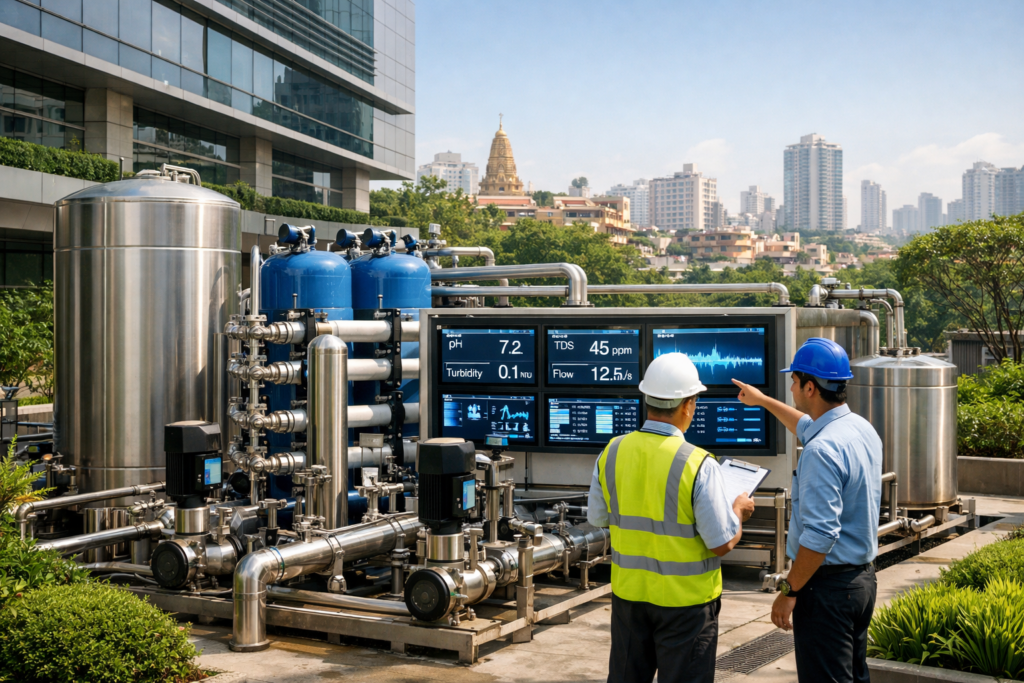
Modern decentralized systems are not just compact—they are intelligent. With IoT sensors, AI-driven automation, and real-time monitoring, these systems continuously track parameters like pH, TDS, and flow rates.
Predictive maintenance prevents breakdowns, automated backwash cycles extend system life, and smart analytics optimize performance. Together, these features create self-sustaining, high-efficiency building ecosystems.
Why Every Building Needs One
As water scarcity increases and environmental regulations tighten, decentralized water treatment is becoming essential for sustainable architecture.
Green building certifications now prioritize water reuse and efficiency. For homeowners, developers, and facility managers, decentralized systems mean:
Reduced dependence on tanker water
Lower compliance risks
Increased property value
Long-term water security
A Step Toward Resilient Urban Infrastructure
Future cities will rely on adaptive, decentralized infrastructure. These systems are scalable, flexible, and resource-efficient, making them ideal for urban resilience.
They address one of humanity’s most critical challenges: ensuring equitable and sustainable access to clean water without overreliance on centralized grids.
GreenSew: Leading the Water Independence Movement
GreenSew Water Solutions is at the forefront of the decentralized water revolution. The company provides modular systems for water treatment, recycling, and reuse, ranging from residential units to large-scale industrial and desalination plants.