
Sewage Treatment Plant in Hyderabad: Complete Guide to STP Solutions, Technologies, Cost & Water Reuse
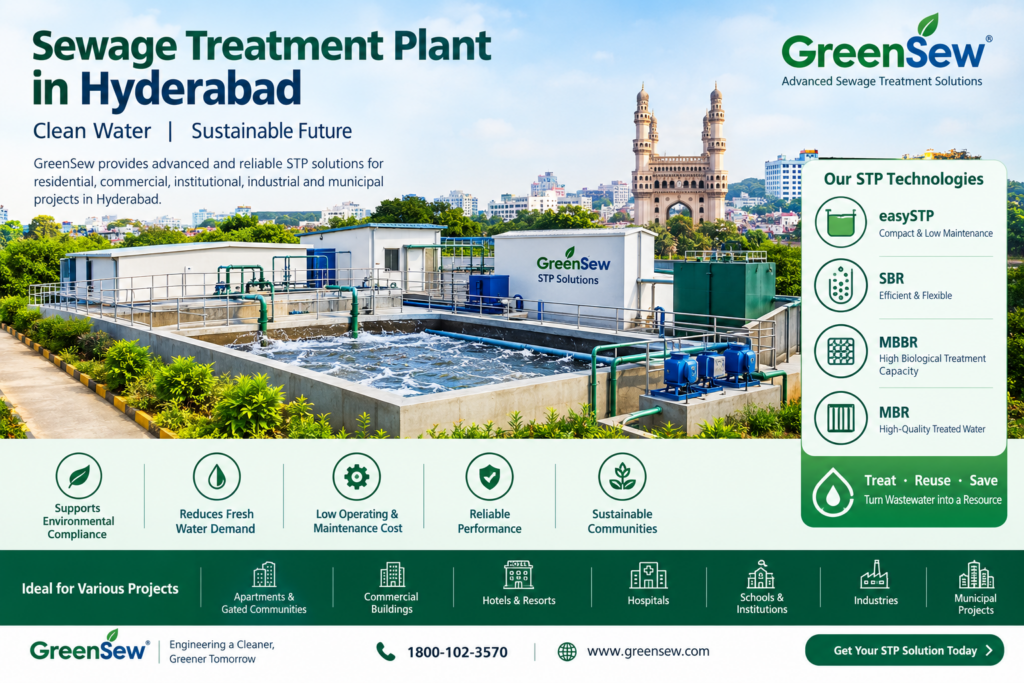
Looking for a sewage treatment plant in Hyderabad? GreenSew provides engineered sewage treatment solutions for apartments, gated communities, commercial buildings, hotels, hospitals, institutions, industries, and municipal applications.
A modernSewage Treatment Plant (STP) treats wastewater generated from buildings and facilities so that the treated water can be safely discharged or reused for suitable non-potable applications such as toilet flushing, gardening, landscaping and other approved uses.
As Hyderabad continues to expand with residential communities, commercial developments, hospitals, hotels, educational institutions and industrial facilities, effective wastewater treatment and reuse have become increasingly important.
GreenSew provides multiple STP technologies, includingeasySTP, SBR, MBBR and MBR, selected according to project capacity, available space, required treated-water quality, operation requirements and reuse objectives.
Quick Answer: What Is a Sewage Treatment Plant?
ASewage Treatment Plant (STP) is an engineered system that treats wastewater generated from toilets, bathrooms, kitchens and other domestic activities.
The treatment process removes suspended solids, organic pollutants and other contaminants from sewage through physical, biological and, where required, tertiary treatment processes.
The treated water can then be used for suitable non-potable applications or discharged according to applicable requirements.
For a project in Hyderabad, the correct STP should be selected based on:
- Daily sewage generation
- Plant capacity in KLD
- Building occupancy
- Type of facility
- Available installation area
- Required treated-water quality
- Water-reuse requirements
- Power availability
- Operator requirements
- Sludge management
- Maintenance requirements
- Applicable regulatory requirements
Why Is a Sewage Treatment Plant Important in Hyderabad?
Hyderabad’s residential, commercial and industrial development creates significant wastewater generation.
Apartments, gated communities, offices, hotels, hospitals, educational campuses and other facilities need an effective method to manage sewage generated on-site.
A properly designed STP can help a project:
- Treat wastewater before disposal or reuse
- Reduce dependence on fresh water for suitable applications
- Reuse treated wastewater
- Support environmental compliance
- Reduce wastewater-related pollution
- Improve water-management efficiency
- Create a more sustainable building operation
Hyderabad’s wastewater infrastructure also includes large municipal treatment systems. At the municipal level, Hyderabad has adopted technologies such as SBR for sewage treatment, while decentralized projects can use different treatment technologies depending on their requirements.
Is an STP Required for Buildings in Hyderabad?
The requirement for an STP depends on the type, scale and approvals applicable to a particular development.
Residential apartments, gated communities, commercial developments, institutions, hotels, hospitals and other large projects may have wastewater-treatment requirements associated with their approvals and applicable pollution-control conditions.
Therefore, a project should not select an STP simply based on capacity or price.
The design should consider:
- Project wastewater generation
- Applicable environmental requirements
- Consent/approval conditions
- Required treated-water quality
- Reuse requirements
- Site constraints
- Operation and maintenance requirements
For project-specific compliance, developers should verify the latest requirements with the relevant authorities and their environmental consultant.
What Is the Capacity of an STP?
STP capacity is normally expressed inKLD, which meanskilolitres per day.
1 KLD = 1,000 litres per day
For example:
- 10 KLD = 10,000 litres/day
- 25 KLD = 25,000 litres/day
- 50 KLD = 50,000 litres/day
- 100 KLD = 100,000 litres/day
- 500 KLD = 500,000 litres/day
- 1 MLD = 1,000 KLD
The correct STP capacity should be calculated from expected water consumption and sewage generation rather than simply selecting a standard plant size.
How Do You Calculate STP Capacity?
A basic preliminary calculation can be made from the expected population and per-person water consumption.
Example
Suppose an apartment project has:
200 people
If the estimated water consumption is:
120 litres/person/day
Then:
200 × 120 = 24,000 litres/day
That equals:
24 KLD water consumption
If approximately 80% is considered sewage generation for preliminary planning:
24 × 0.80 = 19.2 KLD sewage
The final design capacity should then be established by the project’s engineer based on actual design assumptions, peak flows, occupancy and applicable standards.
This is why an STP should beengineered according to the project, rather than selected only from a catalogue.
What Types of Projects Need Sewage Treatment Plants in Hyderabad?
GreenSew can design sewage treatment solutions for different types of facilities.
1. Apartments and Gated Communities
Residential developments generate sewage continuously from:
- Toilets
- Bathrooms
- Kitchens
- Laundry
- Common facilities
An STP allows treated wastewater to be managed and potentially reused for applications such as flushing and landscaping.
2. Villas and Residential Communities
Villa developments may require decentralized or centralized wastewater treatment depending on their layout, occupancy and sewage-generation pattern.
Compact solutions can be useful where available space is limited.
3. Commercial Buildings
Office buildings, shopping centres and commercial developments can generate significant wastewater.
An STP can provide a structured wastewater-treatment and reuse system.
4. Hotels and Resorts
Hotels may experience significant variations in wastewater generation depending on occupancy.
The treatment system therefore needs to accommodate variations in hydraulic and organic loading.
5. Hospitals
Hospital wastewater management requires careful engineering because wastewater characteristics can differ from ordinary domestic sewage.
The treatment design should consider the specific wastewater characteristics and applicable requirements.
6. Schools and Institutions
Schools, colleges and campuses can generate wastewater from:
- Toilets
- Hostels
- Canteens
- Laboratories
- Staff facilities
The STP capacity should be based on expected occupancy and water consumption.
7. Industrial Facilities
Industrial facilities may generate both domestic sewage and process wastewater.
An STP is generally intended for sewage/domestic wastewater. Industrial process wastewater may require an appropriately designedEffluent Treatment Plant (ETP) or another treatment system.
8. Municipal and Large Developments
Large municipal and urban wastewater applications can require high-capacity treatment systems with automation, monitoring and centralized operation.
How Does a Sewage Treatment Plant Work?
A typical STP uses several treatment stages.
The exact process depends on the selected technology.
Stage 1: Screening
Incoming sewage passes through screens that remove larger materials such as:
- Plastic
- Cloth
- Paper
- Hair
- Other floating solids
This protects downstream equipment.
Stage 2: Grit and Preliminary Treatment
Heavy inorganic particles and other unwanted materials may be separated during preliminary treatment.
Stage 3: Equalization
An equalization tank can help balance variations in wastewater flow and loading before biological treatment.
Stage 4: Biological Treatment
This is one of the most important stages.
Microorganisms break down biodegradable organic matter present in sewage.
Depending on the selected system, this may involve technologies such as:
- SBR
- MBBR
- MBR
- Extended aeration
- Other biological processes
Stage 5: Solid-Liquid Separation
The treated biological mixture is separated from the water using the appropriate clarification or membrane process.
Stage 6: Tertiary Treatment
Depending on the required water quality, additional treatment can include:
- Filtration
- Disinfection
- UV treatment
- Chlorination
- Membrane treatment
Stage 7: Treated Water Reuse
After achieving the required quality, treated water can be directed toward suitable reuse applications.
What Are the Main STP Technologies Available in Hyderabad?
There isno single STP technology that is automatically suitable for every project.
Technology selection depends on capacity, footprint, treated-water quality, power requirements, operating conditions, budget and operator capability.
The commonly considered technologies include SBR, MBBR and MBR.
SBR – Sequential Batch Reactor
SBR stands for Sequential Batch Reactor.
SBR treats sewage in batches through programmed treatment cycles.
A typical cycle may include:
- Fill
- Aeration/reaction
- Settling
- Decant
- Idle
One of the characteristics of SBR is that several treatment functions can occur within the same reactor.
SBR is used in a range of residential, institutional and municipal wastewater applications.
Hyderabad’s municipal wastewater infrastructure has also used SBR technology.
Potential advantages of SBR
- Compact process configuration
- Automated cycle operation
- Flexible treatment cycles
- Effective biological treatment
- Suitable for variable wastewater loads when properly designed
MBBR – Moving Bed Biofilm Reactor
MBBR stands for Moving Bed Biofilm Reactor.
MBBR uses specially designed carrier media inside a biological reactor.
Microorganisms grow on the media and help break down organic pollutants.
Potential advantages of MBBR
- Continuous-flow operation
- Biofilm-based biological treatment
- Compact biological reactor
- Flexible process design
- Suitable for several domestic wastewater applications
MBBR is widely considered when biological treatment capacity needs to be achieved within a relatively compact footprint.
MBR – Membrane Bioreactor
MBR stands for Membrane Bioreactor.
MBR combines biological treatment with membrane separation.
The membrane acts as a physical separation barrier, allowing high-quality treated water to be produced when the system is correctly designed and operated.
Potential advantages of MBR
- High-quality treated water
- Small footprint
- Effective solid separation
- Suitable for applications requiring higher-quality reuse water
However, MBR systems require appropriate membrane management, cleaning and operational control.
Therefore, MBR should be selected when its performance characteristics justify the additional system complexity and operating requirements.
What Is easySTP by GreenSew?
easySTP is GreenSew’s compact sewage treatment solution designed around simplified installation, operation and maintenance.
GreenSew positions easySTP for applications where project owners require a compact and practical sewage-treatment solution.
According to GreenSew, easySTP is designed for low-maintenance operation and is suitable for different project applications.
Potential applications include:
- Apartments
- Villas
- Hotels
- Commercial buildings
- Institutions
- Small and medium facilities
The appropriate capacity and configuration should be determined according to actual project requirements.
How Do You Choose the Right STP Technology?
Instead of asking:
“Which STP technology is the best?”
A better question is:
“Which STP technology is appropriate for my project?”
Consider these factors:
1. Required Capacity
Determine the actual sewage generation in KLD.
2. Available Space
A project with limited footprint may require a different configuration from a project with abundant land.
3. Treated Water Requirement
If water will be reused for flushing, gardening or another application, establish the required treated-water quality before selecting the technology.
4. Power Availability
Aeration and pumping can significantly influence STP operating costs.
5. Operator Skill
A sophisticated plant may require more technical monitoring and maintenance.
6. Sludge Management
Sludge generation and disposal should be included in the operating plan.
7. Maintenance
The availability of spare parts, servicing and trained technicians should be considered.
8. Lifecycle Cost
Don’t compare STPs only by purchase price.
Consider:
CAPEX + electricity + chemicals + manpower + maintenance + sludge management + replacement costs
What Is the Cost of an STP in Hyderabad?
There isno single fixed price for a sewage treatment plant in Hyderabad.
STP cost depends on:
- Capacity
- Technology
- Civil construction
- Equipment
- Automation
- Pumps and blowers
- Filtration
- Disinfection
- Electrical systems
- Instrumentation
- Installation
- Commissioning
- Treated-water requirements
- Site conditions
- Sludge-handling requirements
For example, a small packaged STP and a large centralized STP may have completely different CAPEX and OPEX structures.
Therefore, a reliable quotation should be prepared only after understanding the project’s technical requirements.
What Should You Check Before Buying an STP?
Before comparing quotations from STP suppliers, ask for a clear technical and commercial proposal.
Your STP quotation should clearly mention:
- Design capacity
- Process flow diagram
- Technology
- Tank specifications
- Equipment specifications
- Pump details
- Blower details
- Electrical requirements
- Automation scope
- Instrumentation
- Expected treated-water quality
- Sludge-management arrangement
- Installation scope
- Commissioning scope
- Warranty
- AMC options
- Consumables
- Spare parts
- Power consumption assumptions
- Civil-work exclusions
- Taxes and transportation
A low-cost quotation is not necessarily the lowest-cost solution over the plant’s operating life.
What Can Treated STP Water Be Used For?
Properly treated wastewater can potentially be reused for suitablenon-potable applications, subject to the required quality and applicable regulations.
Common reuse applications include:
- Toilet flushing
- Gardening
- Landscaping
- Construction activities
- Cooling applications
- Other approved non-potable uses
GreenSew also highlights treated-water reuse as an important part of wastewater management.
Important
Treated sewage water shouldnot automatically be considered drinking water.
Potable reuse requires a substantially different treatment and monitoring framework.
Why Is Water Reuse Important for Hyderabad?
Water reuse can help reduce the demand for fresh water in applications that do not require potable water.
For example, a residential community may use treated wastewater for:
STP → Treatment → Filtration/Disinfection → Storage → Flushing/Gardening
This creates a circular approach to water management:
Fresh Water → Consumption → Sewage → STP → Treated Water → Reuse
Instead of treating wastewater only as waste, a project can manage it as a potential water resource.
How Can GreenSew Help With STP Projects in Hyderabad?
GreenSew is an engineering-focused sewage and wastewater treatment company offering solutions for residential, commercial, institutional, industrial and municipal applications.
GreenSew’s Hyderabad STP solutions include:
easySTP
Compact sewage treatment solution designed for simplified installation and maintenance.
easySBR
A batch-based biological treatment solution using SBR principles.
MBBR
Biofilm-based biological treatment for sewage applications.
MBR
Membrane-based biological treatment for applications requiring higher-quality treated water.
Municipal STP Solutions
GreenSew also provides larger sewage-treatment solutions for municipal and infrastructure applications.
GreenSew describes its approach as engineering sewage-treatment systems around real-world Indian operating conditions, with an emphasis on practical operation and long-term performance.
GreenSew STP Solutions for Different Hyderabad Projects
Project Type | Possible STP Approach |
Apartments | easySTP / SBR / MBBR / MBR |
Gated Communities | SBR / MBBR / MBR |
Villas | Compact STP solutions |
Hotels | SBR / MBBR / MBR |
Hospitals | Engineered biological + tertiary treatment |
Schools | Compact or centralized STP |
Commercial Buildings | SBR / MBBR / MBR |
Industries | STP for domestic sewage; ETP for process wastewater |
Municipal Projects | Large-scale engineered STP systems |
The final technology should be selected after assessing the actual project.
STP Installation Process in Hyderabad
A professional STP project generally involves several stages.
Step 1: Project Requirement Assessment
Collect:
- Building type
- Occupancy
- Water consumption
- Sewage generation
- Capacity requirement
- Site area
- Reuse requirement
Step 2: Capacity Calculation
Determine the required KLD capacity based on design population and wastewater generation.
Step 3: Technology Selection
Select the treatment technology based on:
- Capacity
- Space
- Effluent requirements
- OPEX
- Power
- Operator requirements
Step 4: Engineering Design
Prepare:
- Process design
- P&ID
- Equipment sizing
- Tank sizing
- Electrical requirements
- Automation requirements
Step 5: Manufacturing / Civil Construction
Depending on the selected STP configuration, the system may use prefabricated equipment, FRP/packaged components, RCC tanks or a combination.
Step 6: Installation
Equipment is installed and interconnected with:
- Pumps
- Blowers
- Piping
- Electrical panels
- Instrumentation
- Automation systems
Step 7: Commissioning
The plant is tested and biological treatment is established.
Step 8: Operation & Maintenance
Regular operation and maintenance are essential for stable STP performance.
What Happens If an STP Is Poorly Designed or Maintained?
An STP can underperform when its design, installation or operation does not match the project’s actual conditions.
Common problems can include:
- Bad odour
- Excessive sludge
- Poor treated-water quality
- High electricity consumption
- Pump failures
- Blower failures
- Foaming
- Blockages
- Biological-treatment instability
- Poor reuse-water quality
- Frequent breakdowns
This is why choosing an STP supplier should involve more than comparing equipment prices.
The plant should be evaluated as a complete engineering system.
How Can STP Operating Costs Be Reduced?
STP OPEX can be influenced by several factors.
Efficient aeration
Aeration is often an important energy consumer in biological treatment.
Correct equipment sizing
Oversized equipment can increase capital and operating costs.
Automation
Appropriate automation can reduce unnecessary equipment runtime and simplify monitoring.
Preventive maintenance
Regular maintenance can prevent expensive breakdowns.
Water reuse
Using treated water for suitable non-potable applications can reduce fresh-water demand.
Correct loading
Operating an STP within its intended design range is important for stable performance.
Why Choose GreenSew for a Sewage Treatment Plant in Hyderabad?
GreenSew focuses on sewage and wastewater engineering rather than treating an STP as simply a piece of equipment.
The company provides solutions across different technologies and project sizes.
GreenSew’s approach focuses on:
- Application-specific design
- Practical engineering
- Compact solutions
- Water reuse
- Lower maintenance requirements
- Automation where appropriate
- Project-specific technology selection
- Installation and commissioning
- Long-term operational support
For a project in Hyderabad, the appropriate STP should be selected after assessing the actual wastewater generation, site constraints and treatment requirements.
Frequently Asked Questions About Sewage Treatment Plants in Hyderabad
1. What is a sewage treatment plant?
A sewage treatment plant is a system that treats wastewater generated by residential, commercial, institutional or other facilities before reuse or disposal.
2. What does KLD mean in an STP?
KLD meansKilolitres Per Day.
A 50 KLD STP is designed for approximately 50,000 litres of wastewater per day under its design conditions.
3. How do I calculate the STP capacity for an apartment?
Start with the expected population and daily water consumption, then estimate the percentage becoming sewage. Peak flow, occupancy patterns and applicable design criteria should also be considered.
4. Which STP technology is suitable for apartments in Hyderabad?
SBR, MBBR, MBR and compact packaged solutions can all be considered depending on capacity, available space, treated-water requirements, budget and operational conditions.
5. What is the difference between STP and ETP?
AnSTP primarily treats domestic sewage.
AnETP, or Effluent Treatment Plant, is designed to treat industrial process wastewater.
The correct system depends on the wastewater characteristics.
6. Can STP water be reused?
Yes. Properly treated wastewater can be reused for suitable non-potable applications such as flushing, gardening and landscaping, provided the treated water meets the requirements for that application.
7. How much does an STP cost in Hyderabad?
STP cost depends on capacity, technology, construction, equipment, automation, installation, treatment requirements and other project-specific factors. A technical assessment is required for an accurate quotation.
8. How much space is required for an STP?
Space requirements vary according to capacity, technology, tank configuration, equipment arrangement and site conditions.
Compact technologies can reduce the footprint, but the complete plant—including access, electrical systems, sludge handling and maintenance space—must be considered.
9. Does an STP require an operator?
The operator requirement depends on the technology, capacity, automation and operating strategy.
Some modern systems can simplify routine operation, but every STP still requires appropriate inspection, maintenance and monitoring.
10. How often should an STP be maintained?
Preventive maintenance should be performed according to the equipment manufacturer’s recommendations and the operating conditions of the plant.
Pumps, blowers, aeration systems, electrical panels, sensors, membranes and other equipment may have different maintenance schedules.
11. Can GreenSew design an STP for a new apartment project?
Yes. GreenSew provides sewage-treatment solutions for residential developments, including apartments and gated communities.
12. Can GreenSew provide STP solutions for commercial buildings?
Yes. Commercial buildings can be assessed for suitable sewage-treatment technologies based on occupancy, wastewater generation, available space and reuse requirements.
13. Can an STP be installed in a small space?
Compact STP technologies can be considered when space is limited. The final configuration depends on capacity and required treatment quality.
14. What information is required to get an STP quotation?
Typically, the supplier will need:
- Project type
- Location
- Number of residents/users
- Water consumption
- Required STP capacity
- Site layout
- Available space
- Treated-water reuse requirement
- Civil-work status
- Required treated-water quality
Providing these details allows the supplier to prepare a more meaningful proposal.
How to Get a Sewage Treatment Plant Quote in Hyderabad
If you are planning an apartment, commercial building, hotel, hospital, institution, industrial facility or other development in Hyderabad, start by determining your approximate sewage generation.
Then discuss:
Capacity → Technology → Footprint → Treated-water quality → Reuse → CAPEX → OPEX → Maintenance
GreenSew can evaluate the project requirements and recommend a suitable sewage-treatment configuration.
Need an STP for your Hyderabad project?
Talk to GreenSew for an STP requirement assessment, capacity recommendation and project-specific quotation.
GreenSew Infratech Pvt. Ltd.
Advanced Sewage Treatment Solution Provider
📞1800-102-3570
🌐greensew.com
Serving residential, commercial, institutional, industrial and municipal wastewater-treatment requirements.
Final Takeaway
Asewage treatment plant in Hyderabad is not simply a tank with pumps and blowers. It is a complete wastewater-treatment system that needs to be correctly designed, sized, installed, commissioned and maintained.
The right STP depends on:
Project → Sewage Generation → Capacity → Technology → Space → Treatment Quality → Reuse → OPEX → Maintenance
Technologies such asSBR, MBBR, MBR and compact packaged STPs can serve different project requirements.
For Hyderabad projects, selecting the appropriate technology and designing the system around actual site conditions can help create a more reliable wastewater-treatment and water-reuse system.
GreenSew provides engineered sewage treatment solutions designed for practical operation, water reuse and long-term wastewater management.