
Modern Sewage Treatment Plant in Hyderabad: Technologies, Process & Sustainable Water Management in 2026
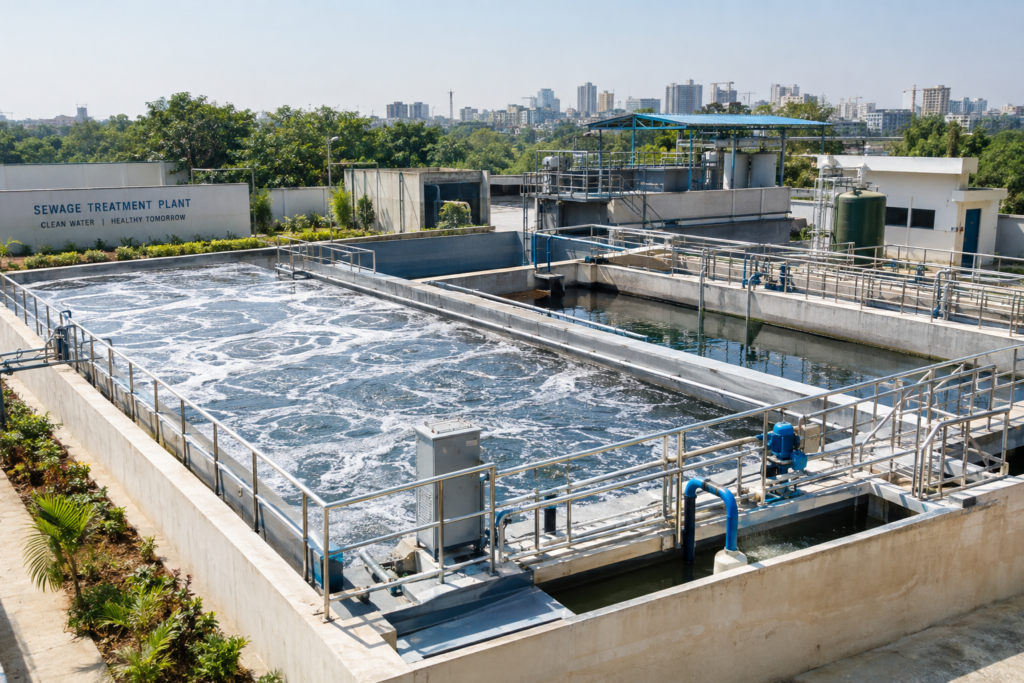
Hyderabad is experiencing rapid growth across residential communities, commercial developments, hotels, hospitals, educational institutions, industries and infrastructure projects. As the city grows, so does the volume of wastewater generated every day. Managing this wastewater responsibly has become an important part of modern urban development.
Amodern sewage treatment plant in Hyderabad is no longer simply a compliance requirement. With the right technology and design, an STP can become an important part of a project’s overall water-management strategy by treating sewage, reducing pollution and enabling treated-water reuse.
Modern sewage treatment technologies such asMBBR, SBR, MBR, UF and compact biological treatment systems provide different options depending on project capacity, available space, treated-water quality requirements, operating conditions and budget.
This guide explains how a modern STP works, the major technologies available in 2026, how to calculate approximate capacity, factors to consider when selecting an STP, water-reuse opportunities and common operating challenges.
What Is a Modern Sewage Treatment Plant?
A sewage treatment plant, commonly called anSTP, is a system designed to treat wastewater generated from residential, commercial, institutional or other facilities.
Domestic sewage typically contains organic matter, suspended solids, nutrients, microorganisms and other contaminants. If untreated sewage is discharged directly into the environment, it can negatively affect water bodies, soil and public health.
A modern STP uses a combination of physical, biological and, where required, tertiary treatment processes to reduce pollutants and produce treated water suitable for the intended discharge or reuse application.
How Is a Modern STP Different from a Conventional STP?
Modern STPs increasingly focus on:
- Reliable treatment performance
- Energy-efficient operation
- Compact footprint
- Automation
- Reduced operator dependency
- Online monitoring
- Sludge management
- Treated-water reuse
- Easier maintenance
- Lifecycle operating costs
The appropriate technology depends on the application. There is no single STP technology that is automatically suitable for every project.
For example, a small residential development may prioritize compactness and simple operation, while a large municipal project may require advanced automation, process control and continuous monitoring.
Why Are Sewage Treatment Plants Important for Hyderabad?
The growth of Hyderabad has increased the demand for reliable wastewater infrastructure. Residential communities, IT parks, hotels, hospitals, educational campuses and industrial facilities generate wastewater every day.
A properly designedsewage treatment plant in Hyderabad can help projects:
- Treat wastewater before permitted discharge.
- Reduce the environmental impact of sewage.
- Support responsible water management.
- Enable treated-water reuse for suitable applications.
- Reduce dependence on fresh water for non-potable purposes.
- Support compliance with applicable regulatory requirements.
The objective should therefore move beyond simply installing an STP. The system should be designed, operated and maintained according to the project’s actual sewage generation, treatment requirements and reuse objectives.
How Does a Sewage Treatment Plant Work?
Although STP designs vary, the overall treatment process generally involves several stages.
1. Screening
The first stage is screening.
Screens remove larger materials such as:
- Plastic
- Cloth
- Paper
- Sanitary waste
- Rags
- Other floating or coarse solids
Removing these materials protects pumps, blowers and downstream equipment.
2. Grit Removal
Sewage can contain sand, grit and other heavy inorganic particles.
Grit removal helps prevent unwanted accumulation and abrasion in downstream equipment.
Depending on the plant design, grit removal may be incorporated into the preliminary treatment system.
3. Primary Treatment
Primary treatment generally focuses on separating settleable and suspended solids from incoming sewage.
Gravity-based settling allows heavier solids to settle while lighter materials may float and be removed.
Not every modern STP uses exactly the same configuration. The treatment arrangement depends on the selected process and project requirements.
4. Biological Treatment
Biological treatment is one of the most important stages of an STP.
Microorganisms consume and break down biodegradable organic matter present in sewage. Proper control of biological conditions helps reduce pollutants such as BOD and COD.
Different technologies use different approaches to maintain and control the biological process.
Examples include:
- MBBR
- SBR
- MBR
- Fixed-film biological systems
- Other advanced biological treatment processes
5. Secondary Clarification
In systems that use a separate secondary clarifier, biological solids are separated from the treated wastewater.
The settled biomass may be returned to the biological process or removed as excess sludge depending on the process design.
Some technologies, such as MBR, use membranes instead of conventional secondary clarification.
6. Tertiary Treatment
Tertiary treatment is used when additional polishing or a higher level of treated-water quality is required.
Depending on the application, tertiary treatment can include:
- Filtration
- Ultrafiltration
- Disinfection
- Activated carbon
- Membrane treatment
- Other polishing processes
The required treatment should be based on the final water-quality objective.
For example, an STP designed for a specific non-potable reuse application may require additional treatment compared with a system designed only for another permitted discharge scenario.
7. Sludge Treatment
Treatment produces sludge that must also be managed properly.
Sludge-management systems may include:
- Sludge thickening
- Sludge dewatering
- Mechanical dewatering
- Drying
- Safe transportation and disposal
Equipment such as aMulti Disc Screw Press can be used in suitable applications for mechanical sludge dewatering.
Effective sludge management is important because an STP does not end with the treatment of liquid wastewater.
8. Treated Water Reuse
One of the biggest opportunities offered by modern wastewater treatment is reuse.
Depending on the treated-water quality and applicable requirements, treated sewage may be used for suitable non-potable purposes such as:
- Toilet flushing
- Gardening
- Landscaping
- Construction
- Cooling applications
- Other approved non-potable uses
This approach changes the role of an STP from a wastewater-disposal system into part of a circular water-management strategy.
Modern STP Technologies Used in Hyderabad
Selecting the right technology is one of the most important decisions when planning anSTP plant in Hyderabad.
Different technologies offer different combinations of footprint, automation, treatment performance, energy requirements and operating complexity.
MBBR – Moving Bed Biofilm Reactor
MBBR is a biological wastewater-treatment process that uses specially designed media inside a reactor.
Microorganisms grow on the surface of the media and help treat organic pollutants.
Advantages of MBBR
- Established biological treatment technology
- Continuous treatment process
- Suitable for various applications
- Can be designed for different capacities
- Relatively flexible for biological treatment
MBBR systems can be considered for residential, commercial, institutional and other wastewater-treatment applications.
However, design parameters, aeration requirements, hydraulic loading and operating conditions should be evaluated before selecting the technology.
SBR – Sequential Batch Reactor
SBR stands forSequential Batch Reactor.
Instead of treating wastewater continuously through separate process tanks, an SBR performs different treatment stages sequentially within a reactor.
Typical stages can include:
- Fill
- React
- Settle
- Decant
- Idle
Advantages of SBR
- Integrated biological treatment
- Automated sequencing
- Reduced need for separate clarifiers in some configurations
- Suitable for a wide range of applications
- Can provide effective treatment when properly designed and operated
SBR systems are often considered for projects where automation and process control are important.
MBR – Membrane Bioreactor
MBR combines biological treatment with membrane filtration.
The membrane system provides a physical barrier for suspended solids and microorganisms, producing high-quality treated water when appropriately designed and operated.
Advantages of MBR
- High-quality treated water
- Compact footprint compared with some conventional configurations
- Suitable for applications requiring higher-quality reuse water
- Low suspended-solids concentration in membrane permeate
The main considerations include membrane cost, energy consumption, membrane fouling management and maintenance requirements.
For projects where water reuse and limited space are important considerations, MBR can be evaluated as part of the treatment strategy.
UF – Ultrafiltration
Ultrafiltration is a membrane-based treatment process.
UF membranes can remove fine suspended particles and other contaminants depending on membrane characteristics and operating conditions.
UF can be used as part of a tertiary treatment or water-reuse system.
For projects requiring higher-quality reuse water, UF may be combined with other treatment technologies based on the target application.
Compact STP and Johkasou-Based Treatment
Compact decentralized wastewater-treatment systems can be useful where space, installation time and operator availability are important considerations.
Johkasou-based approaches use compact biological treatment concepts and are particularly relevant to decentralized wastewater treatment.
Compact systems can be evaluated for:
- Apartments
- Villas
- Small communities
- Hotels
- Institutions
- Commercial facilities
The final selection should still be based on sewage characteristics, capacity, discharge/reuse requirements and site conditions.
Municipal Sewage Treatment Technologies
Large developments and municipalities have different requirements compared with individual buildings.
Amunicipal sewage treatment plant in Hyderabad may involve:
- Large hydraulic flows
- Variable sewage characteristics
- Automated process control
- Multiple treatment stages
- Sludge management
- Online monitoring
- SCADA systems
- Expansion requirements
SBR and other large-scale biological treatment configurations can be designed for municipal applications.
For large projects, engineering should consider both present requirements and future expansion.
How to Choose the Right STP Technology for Your Project
There is no universal answer to the question, “Which STP technology is best?”
The appropriate choice depends on the project.
1. Determine Sewage Flow
The first requirement is understanding how much sewage the project is expected to generate.
Consider:
- Population
- Occupancy
- Water consumption
- Peak flow
- Seasonal variations
- Future expansion
Capacity should not simply be selected based on the number of people without considering actual project conditions.
2. Consider Available Space
Space can significantly influence technology selection.
Urban projects may have limited available land, making compact treatment systems attractive.
Consider:
- Plant footprint
- Tank configuration
- Equipment area
- Sludge-handling area
- Access for maintenance
- Future expansion
3. Define Treated-Water Requirements
Before selecting an STP, determine what will happen to the treated water.
Will it be:
- Discharged?
- Used for gardening?
- Used for toilet flushing?
- Used for cooling?
- Sent for additional membrane treatment?
The final application influences the required treatment process.
4. Compare CAPEX and OPEX
A low initial quotation does not necessarily mean a lower overall project cost.
Compare:
- Equipment cost
- Civil work
- Installation
- Electricity consumption
- Chemicals
- Operator cost
- Spare parts
- Sludge disposal
- Preventive maintenance
- AMC
- Expected lifecycle cost
For this reason, buyers should comparelifecycle costs rather than quotation price alone.
5. Evaluate Operator Requirements
Some systems require more operational attention than others.
Consider:
- Number of operators
- Skill level
- Daily operating time
- Automation
- Alarm systems
- Remote monitoring
- Maintenance requirements
Automation can reduce manual intervention, but it does not eliminate the need for proper inspection and maintenance.
How Much STP Capacity Does Your Hyderabad Project Need?
STP capacity is generally expressed inKLD – Kilolitres per Day.
One KLD is equivalent to 1,000 litres per day.
A basic conceptual calculation can be:
Population × Water Consumption per Person × Sewage Generation Factor = Approximate Sewage Generation
Example
Consider a project with:
- 200 people
- Water consumption = 120 litres/person/day
- Sewage generation factor = 80%
Calculation:
200 × 120 × 80% = 19,200 litres/day
Therefore:
19,200 litres/day = 19.2 KLD
This is an illustrative calculation, not an automatic recommendation that the project should install a 20 KLD STP.
Actual STP capacity should be determined using project-specific information, applicable design criteria, peak flows, occupancy and other engineering considerations.
This is particularly important when planning a20 KLD sewage treatment plant, because the nominal capacity should correspond to the actual hydraulic and organic loading expected at the site.
STP Compliance Requirements in Hyderabad
Compliance is an important part of wastewater-treatment planning.
Depending on the project, applicable requirements may involve authorities such as theTelangana Pollution Control Board and relevant central or local regulations.
Typical wastewater-quality parameters can include:
- pH
- BOD
- COD
- TSS
- Nitrogen parameters where applicable
- Other parameters depending on the discharge or reuse application
The exact requirements can vary depending on:
- Type of project
- Discharge location
- Reuse application
- Consent conditions
- Applicable regulations
- Local requirements
Therefore, project owners should verify the current applicable standards and consent conditions before finalizing the STP design.
Compliance should be considered from the beginning rather than after installation.
STP Automation and Smart Monitoring in 2026
Automation is becoming increasingly important in modern wastewater treatment.
PLC and SCADA
PLC-based control systems can automate equipment and process sequences.
SCADA can provide:
- Process visualization
- Equipment status
- Alarm monitoring
- Data logging
- Trend analysis
- Operator interface
For larger systems, SCADA can provide greater visibility into plant performance.
Online Monitoring
Depending on regulatory and project requirements, monitoring systems may track parameters such as:
- Flow
- pH
- TSS
- Other required parameters
Where applicable, online monitoring or OCEMS requirements should be incorporated into the engineering design.
Remote Monitoring
Remote monitoring can help plant operators and facility managers track equipment and process conditions without being physically present at the plant continuously.
Potential benefits include:
- Fault alerts
- Equipment status monitoring
- Performance tracking
- Faster response
- Operational data availability
Sustainable Water Management Through STPs
A modern STP should be viewed as part of a broader water-management system.
Instead of simply treating sewage and discharging it, projects can explore opportunities to recover and reuse water.
From Wastewater Treatment to Water Reuse
The concept is straightforward:
Fresh Water → Use → Sewage → Treatment → Reuse
This creates an opportunity to reduce freshwater demand for suitable non-potable applications.
For example, treated water may be considered for:
- Landscape irrigation
- Toilet flushing
- Construction
- Cooling
- Other approved applications
The treatment level required depends on the intended reuse.
Common Problems with STPs in Hyderabad
Installing an STP does not automatically guarantee successful operation.
Several problems can occur when the plant is poorly designed, incorrectly operated or inadequately maintained.
STP Installed but Not Operating Properly
Potential causes include:
- Incorrect capacity
- Poor hydraulic design
- Inadequate aeration
- Organic overloading
- Poor operation
- Insufficient maintenance
- Equipment failure
The solution is usually a combination of engineering review, operational assessment and corrective maintenance.
High Electricity Consumption
Electricity can be a significant component of STP OPEX.
Major energy-consuming equipment can include:
- Blowers
- Pumps
- Mixers
- Membrane systems
Energy optimization should therefore be considered during the design stage.
Bad Odour
Odour can result from conditions such as:
- Septic sewage
- Inadequate aeration
- Sludge accumulation
- Overloading
- Poor housekeeping
Correct process control and regular maintenance are important for odour management.
Poor Treated-Water Quality
Poor outlet quality can have several causes:
- Hydraulic overloading
- Biological imbalance
- Equipment malfunction
- Poor sludge management
- Inadequate aeration
- Insufficient tertiary treatment
Regular monitoring can help identify problems before they become major operational issues.
How to Reduce STP Operating Costs
A well-designed STP should consider operating costs from the beginning.
Optimize Aeration
Aeration is often a major energy-consuming process. Proper blower selection and process control can help optimize energy use.
Use Energy-Efficient Equipment
Evaluate pumps, blowers, mixers and other equipment based on actual duty requirements.
Automate Process Control
Automation can help prevent unnecessary equipment operation and maintain consistent treatment conditions.
Monitor Actual Flow
Understanding actual sewage flow can help operators identify underloading, overloading and abnormal conditions.
Maintain Equipment
Preventive maintenance helps reduce unexpected breakdowns.
Manage Sludge Properly
Efficient sludge handling can reduce operational difficulties and disposal-related problems.
Reuse Treated Water
Using treated water for suitable non-potable applications can reduce freshwater demand.
Prefabricated STP vs Civil STP
When planning asewage treatment plant for an apartment in Hyderabad, developers may evaluate prefabricated and civil-based systems.
Factor | Prefabricated STP | Civil STP |
Installation | Factory-fabricated components can simplify site installation | More construction work at site |
Construction time | Can be shorter depending on project | Can require longer civil construction |
Quality control | Fabrication can occur under controlled conditions | Greater dependence on site construction quality |
Site requirements | Can be suitable for constrained sites depending on design | May require more civil space |
Customization | Available depending on supplier | Highly customizable |
Expansion | Depends on system design | Can be incorporated during civil planning |
Maintenance | Depends on equipment and design | Depends on configuration |
Suitability | Project-specific | Project-specific |
Neither approach should be selected solely because of installation type. The project should be evaluated based on site conditions, capacity, design life, lifecycle cost, construction requirements and operational needs.
What Should You Check Before Buying an STP in Hyderabad?
If you are searching for anSTP manufacturer in Hyderabad, compare suppliers based on engineering and lifecycle factors rather than only price.
Ask for Process Design
Understand the treatment sequence and design basis.
Check Performance Parameters
Ask what treated-water quality the system is designed to achieve under the specified conditions.
Review Equipment Specifications
Check:
- Pumps
- Blowers
- Motors
- Membranes
- Control panels
- Instrumentation
Ask About Power Consumption
Request the expected operating power requirement and understand the basis of the calculation.
Understand Sludge Management
Ask how sludge will be collected, dewatered and handled.
Review Automation
Understand the level of PLC, SCADA and monitoring provided.
Check Warranty
Review warranty conditions for equipment and system components.
Ask About AMC
Understand what preventive maintenance and after-sales support are available.
Visit an Operating Reference Plant
Where possible, seeing an operating plant can provide useful practical information about equipment, noise, odour, maintenance and treated-water quality.
STP Applications in Hyderabad
Modern wastewater-treatment systems can be designed for many applications.
Residential Apartments
Apartment complexes require reliable treatment because sewage generation varies according to occupancy.
Gated Communities
Large communities may require centralized wastewater treatment and treated-water reuse.
Hotels and Resorts
Hotels can have significant variations in daily sewage flow depending on occupancy.
Hospitals
Hospital wastewater requires project-specific assessment and treatment considerations.
Schools and Institutions
Institutional projects may have varying occupancy patterns and operating schedules.
Commercial Buildings
Office buildings and commercial developments can use STPs as part of their wastewater-management infrastructure.
Industrial Facilities
Industrial projects require careful characterization of wastewater because industrial effluent and domestic sewage may require different treatment strategies.
Municipalities
Municipal projects involve larger flows and may require sophisticated automation, monitoring, sludge handling and process management.
GreenSew’s Modern Sewage Treatment Solutions
GreenSew provides wastewater-treatment solutions for different project requirements, with an engineering-focused approach to sewage treatment and water management.
Its solution portfolio includes technologies and systems such as:
- Sewage Treatment Plants
- MBBR
- SBR
- MBR
- UF
- easySTP
- easySBR
- easySTP-Municipal
- Sewage Recycle systems
- Water Treatment Plants
- DeSilta
- Sludge dewatering systems
- PLC/SCADA automation
- OCEMS and monitoring solutions
Different technologies can be evaluated based on capacity, site conditions, water-quality requirements, operating requirements and reuse objectives.
For decentralized applications, compact solutions such as easySTP and easySBR can be considered where reduced footprint and simplified operation are important project requirements.
For larger municipal requirements, solutions can be engineered around larger-capacity SBR and automated treatment configurations.
Why Choose an Engineering-Focused STP Solution?
Choosing an STP supplier should involve more than selecting a tank and equipment package.
A wastewater-treatment project involves:
Requirement → Design → Technology Selection → Manufacturing → Installation → Commissioning → Operation → Maintenance → Water Reuse
Each stage can influence the final performance of the system.
An engineering-focused approach considers:
- Actual sewage generation
- Hydraulic and organic loading
- Site constraints
- Required treated-water quality
- Energy consumption
- Sludge management
- Automation
- Maintenance
- Future expansion
- Water-reuse objectives
This approach helps project owners evaluate the complete lifecycle of the wastewater-treatment system.
Frequently Asked Questions About STPs in Hyderabad
What is an STP?
An STP, or sewage treatment plant, is a system used to treat domestic sewage and wastewater before permitted discharge or suitable reuse.
How does an STP work?
An STP generally combines preliminary, biological and, where required, tertiary treatment processes to remove solids, organic matter and other pollutants.
How is STP capacity calculated?
A basic estimation can consider population, water consumption and the proportion of water expected to become sewage. Actual design capacity requires project-specific engineering assessment.
What is 20 KLD in an STP?
20 KLD means the nominal treatment capacity is 20 kilolitres per day, equivalent to 20,000 litres per day.
Which STP technology is suitable for apartments?
MBBR, SBR, MBR and compact biological systems can all be considered depending on the apartment’s capacity, available space, treated-water requirements, budget and operating conditions.
What is the difference between MBBR and SBR?
MBBR is a continuous biological treatment process using attached-growth media, while SBR uses sequential treatment phases in a reactor.
What is the difference between SBR and MBR?
SBR uses sequential biological treatment and settling/decanting, while MBR combines biological treatment with membrane separation.
Can treated sewage water be reused?
Yes. Properly treated wastewater can be reused for suitable non-potable applications where the water quality and applicable requirements permit it.
How much space does an STP require?
Space requirements depend on capacity, technology, tank configuration, equipment and site conditions.
How much electricity does an STP consume?
Electricity consumption varies significantly depending on technology, capacity, loading, aeration requirements, pumping and membrane systems where applicable.
How often does an STP require maintenance?
Maintenance requirements depend on the technology and equipment. Routine inspection, preventive maintenance, cleaning, calibration and periodic servicing are important for reliable operation.
What are the major STP operating costs?
Major costs can include electricity, manpower, chemicals where used, spare parts, maintenance and sludge handling.
What should I consider when selecting an STP manufacturer in Hyderabad?
Evaluate engineering capability, technology suitability, performance requirements, equipment quality, automation, installation, commissioning, warranty, AMC and lifecycle operating costs.
Conclusion: Building a Sustainable Water Future for Hyderabad
The future of wastewater management is moving beyond simply treating sewage for disposal.
Amodern sewage treatment plant in Hyderabad can become an important component of sustainable water management by combining reliable treatment, efficient operation, automation, sludge management and treated-water reuse.
The right STP technology depends on several factors, including:
- Sewage capacity
- Project type
- Available space
- Treated-water requirements
- CAPEX
- OPEX
- Operator requirements
- Automation
- Sludge management
- Future expansion
Technologies such asMBBR, SBR, MBR, UF and compact biological treatment systems provide different options for different applications.
For developers, facility managers, consultants and project owners, the key is to select a system based on the project’s actual requirements rather than choosing an STP only by its initial quotation price.
A properly engineered wastewater-treatment system can help projects meet applicable requirements, reduce pollution, improve water efficiency and create opportunities for responsible reuse of treated wastewater.
Planning a Sewage Treatment Plant in Hyderabad?
Whether you are developing an apartment, hotel, hospital, commercial building, institution, industrial facility or municipal project, start by understanding your sewage generation, site constraints and treated-water requirements.
GreenSew can help evaluate the project requirements and identify suitable sewage treatment and water-reuse solutions.
Plan your STP. Treat wastewater. Reuse water. Build for a more sustainable future.