
WTP & STP Treatment Plants: Complete Guide to Water and Sewage Treatment Solutions
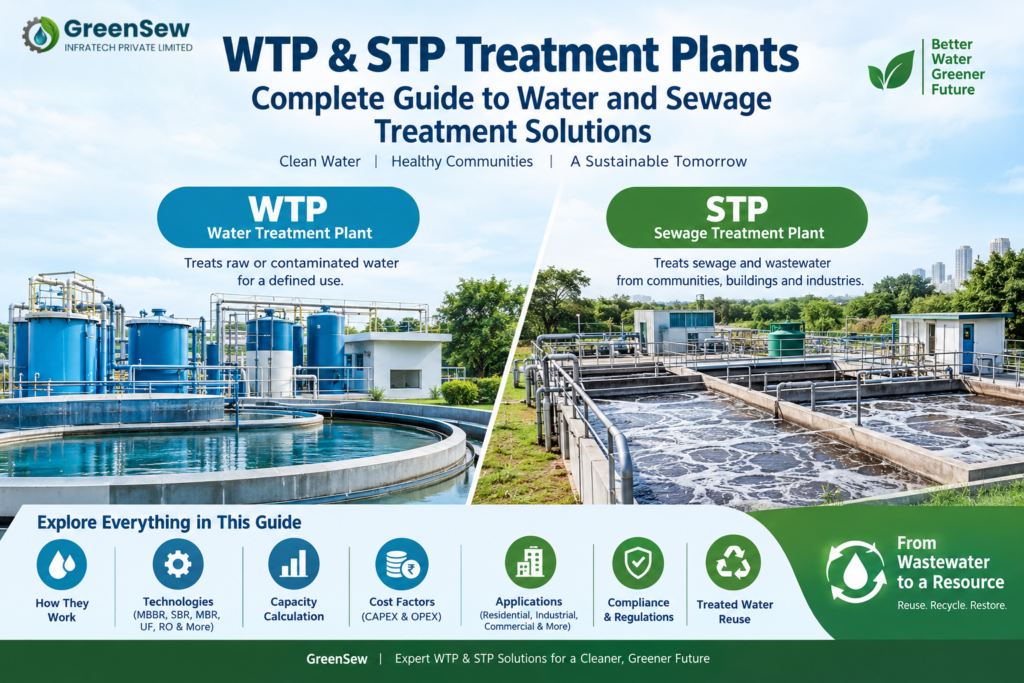
Water and wastewater management has become an essential part of residential, commercial, industrial, institutional, and infrastructure projects across India. As freshwater resources become increasingly important and environmental regulations continue to evolve, organizations need reliable solutions for treating both incoming water and wastewater.
Two important systems used for water management areWTP (Water Treatment Plant) andSTP (Sewage Treatment Plant). Although both are treatment systems, they are designed for different purposes. A WTP primarily treats raw or contaminated water to make it suitable for a specific application, while an STP treats sewage generated from buildings, communities, institutions, and other facilities.
Choosing the right treatment technology depends on several factors, including water or sewage quality, required capacity, treated-water quality, available space, operating conditions, budget, reuse requirements, and applicable regulations.
In this complete guide, we explainwhat WTP and STP treatment plants are, how they work, the difference between WTP and STP, major treatment technologies, capacity calculation, cost considerations, applications, water reuse, and how to select the right treatment solution for your project.
What Is a WTP (Water Treatment Plant)?
AWater Treatment Plant (WTP) is a system designed to treat raw water or contaminated water and improve its quality for a defined end use.
Depending on the source and intended application, water may contain suspended solids, turbidity, organic matter, microorganisms, dissolved minerals, colour, odour, or other contaminants. A WTP uses one or more physical, chemical, and/or membrane-based treatment processes to reduce these contaminants.
The exact treatment process depends on the characteristics of the source water and the quality required after treatment.
Why Is a Water Treatment Plant Required?
A WTP may be required when water needs treatment before it is used for:
- Domestic applications
- Commercial facilities
- Industrial processes
- Institutional facilities
- Municipal water supply
- Cooling systems
- Process applications
- Other defined non-potable or potable applications, where applicable
A properly designed WTP can help improve water quality and provide a more consistent water supply for the intended application.
Where Are WTPs Used?
Water treatment plants are commonly considered for:
- Residential communities
- Apartments
- Hotels and resorts
- Hospitals
- Schools and universities
- Commercial buildings
- Manufacturing facilities
- Industrial plants
- Infrastructure projects
- Municipal applications
The appropriate treatment process should always be selected based on the source-water analysis and required output quality.
What Is an STP (Sewage Treatment Plant)?
ASewage Treatment Plant (STP) is a treatment system designed to treat sewage generated from residential, commercial, institutional, industrial-campus, and other facilities.
Sewage typically contains organic matter, suspended solids, microorganisms, nutrients, and other contaminants. If untreated sewage is discharged improperly, it can create environmental and public-health concerns.
An STP uses a combination of physical, biological, and sometimes chemical or membrane-based processes to treat sewage before discharge or suitable reuse.
Why Is an STP Required?
An STP can help a project:
- Treat wastewater before discharge
- Reduce organic pollution
- Improve treated-water quality
- Support applicable regulatory requirements
- Enable treated wastewater reuse
- Reduce freshwater demand
- Improve overall water management
The final treatment process depends on the characteristics of the incoming sewage and the required quality of the treated water.
Where Are STPs Used?
STPs are commonly used in:
- Apartment complexes
- Gated communities
- Residential developments
- Hotels
- Hospitals
- Schools
- Universities
- Commercial buildings
- IT parks
- Industrial campuses
- Municipal projects
- Infrastructure developments
WTP vs STP: What Is the Difference?
The simplest way to understand the difference between WTP and STP is:
WTP treats water. STP treats sewage.
Parameter | WTP | STP |
Full form | Water Treatment Plant | Sewage Treatment Plant |
Main purpose | Treatment of raw/contaminated water | Treatment of sewage/wastewater |
Input | Raw water or source water | Sewage |
Main contaminants | Turbidity, suspended solids, dissolved contaminants, microorganisms and others depending on source | Organic matter, suspended solids, microorganisms, nutrients and other sewage contaminants |
Output | Treated water for the intended application | Treated sewage suitable for the defined discharge/reuse route |
Common applications | Water supply, industrial/process water and other applications | Discharge, flushing, gardening and other suitable reuse applications |
The two systems can also be part of a broaderintegrated water-management strategy, particularly where treated wastewater is reused and additional water treatment is required for a specific application.
How Does a Water Treatment Plant Work?
There is no single WTP process that is suitable for every water source. Treatment is selected based on raw-water characteristics and the required treated-water quality.
A typical conventional water-treatment process may include the following stages.
1. Raw Water Collection
Raw water is collected from the identified source and transferred to the treatment system.
2. Screening
Screens may be used to remove larger floating materials and physical debris.
3. Coagulation
Coagulants may be added to destabilize fine suspended particles and help them form larger particles.
4. Flocculation
Gentle mixing encourages small particles to combine into larger flocs.
5. Sedimentation
The formed flocs can settle under controlled conditions, reducing suspended solids.
6. Filtration
Filtration systems can further reduce suspended particles and improve water quality.
Depending on the application, technologies such as pressure sand filters, activated carbon filters, ultrafiltration, or other systems may be used.
7. Disinfection
Disinfection may be used to control microorganisms when required by the intended application.
8. Advanced Treatment
Depending on the water-quality requirements, advanced treatment such asUF or RO may be considered.
9. Treated Water Storage
The treated water can be stored and distributed for its intended use.
How Does a Sewage Treatment Plant Work?
An STP generally combines physical and biological processes to treat sewage.
A typical sewage treatment process may include:
1. Sewage Collection
Wastewater from toilets, bathrooms, kitchens, and other sources is collected and transferred to the treatment plant.
2. Screening
Screens remove larger solids and floating materials from incoming sewage.
3. Grit Removal
Grit and heavier inorganic particles may be removed to protect downstream equipment.
4. Primary Treatment
Depending on the selected process, primary treatment may reduce settleable solids and some organic load.
5. Biological Treatment
Microorganisms are used to break down biodegradable organic matter.
This is a key stage in many STP technologies, includingMBBR, SBR, and MBR systems.
6. Secondary Clarification
Where applicable, biological solids can be separated from the treated water through clarification.
7. Tertiary Treatment
Additional treatment may be provided when higher-quality treated water is required, particularly for reuse.
8. Disinfection
Disinfection may be used depending on the treated-water application and applicable requirements.
9. Treated Water Reuse or Discharge
The final treated water can be directed toward an approved discharge route or suitable reuse application.
10. Sludge Management
Sludge generated during treatment needs to be properly handled, dewatered, managed, and disposed of or reused where permitted.
Types of STP Technologies
Different sewage treatment technologies are available for different project requirements.
MBBR STP
MBBR (Moving Bed Biofilm Reactor) uses attached microbial growth on carrier media to support biological treatment.
MBBR systems are widely considered for residential, commercial, institutional, and other sewage-treatment applications.
Important factors include:
- Required capacity
- Organic loading
- Hydraulic loading
- Aeration requirements
- Space
- Treated-water quality
- Operation and maintenance
SBR STP
SBR (Sequencing Batch Reactor) performs different treatment stages in a controlled sequence within reactor tanks.
Typical stages can include:
- Fill
- React
- Settle
- Decant
- Idle
SBR systems can be automated and may be suitable for projects where controlled biological treatment and process flexibility are required.
MBR STP
MBR (Membrane Bioreactor) combines biological treatment with membrane separation.
The membrane process can produce high-quality treated water and can be considered for projects where water reuse and a compact treatment footprint are important.
FRP and Prefabricated STP
Prefabricated andFRP sewage treatment plants can provide a factory-manufactured approach to STP construction.
Potential advantages include:
- Faster installation
- Factory-controlled manufacturing
- Compact construction
- Reduced on-site fabrication
- Suitable configurations for different project requirements
The actual installation time depends on civil works, site readiness, transportation, plant configuration, and project scope.
Compact STP Solutions
Compact STPs are designed to provide treatment within a relatively small footprint.
They can be considered for:
- Residential buildings
- Villas
- Small commercial facilities
- Hotels
- Institutions
- Other space-constrained projects
Technology selection should be based on actual sewage characteristics and project requirements rather than plant size alone.
Types of WTP Technologies
Water treatment requirements vary considerably depending on the water source.
Common WTP technologies include:
Conventional Water Treatment
Conventional treatment can combine coagulation, flocculation, sedimentation, filtration, and disinfection.
Pressure Sand Filter
A pressure sand filter can be used to reduce suspended solids and turbidity as part of a larger treatment system.
Activated Carbon Filter
Activated carbon filtration may help reduce certain organic compounds, colour, taste, and odour depending on the water characteristics.
Ultrafiltration (UF)
UF uses membranes to separate suspended solids, colloids, and microorganisms depending on membrane characteristics and operating conditions.
Reverse Osmosis (RO)
RO is a membrane process commonly considered when dissolved salts and other contaminants need significant reduction.
RO should not automatically be considered necessary for every WTP. It is selected based on water analysis and the required treated-water quality.
How to Select the Right WTP or STP
Selecting a treatment plant is more than choosing a capacity and comparing quotations.
1. Determine the Required Capacity
For an STP, determine:
- Population
- Water consumption
- Sewage generation
- Peak flow
- Seasonal variations
- Future expansion
For a WTP, consider:
- Raw-water demand
- Source availability
- Daily consumption
- Peak demand
- Process-water requirements
- Future expansion
2. Test the Incoming Water or Sewage
Treatment technology should be based on actual input characteristics.
For WTPs, parameters may include turbidity, TDS, hardness, pH, iron, organic matter, microbiological parameters, and other relevant parameters.
For STPs, parameters can include:
- BOD
- COD
- TSS
- pH
- Nutrients
- Flow characteristics
- Other project-specific parameters
3. Define the Required Output Quality
Ask:
Where will the treated water go?
Possible applications include:
- Toilet flushing
- Gardening
- Landscaping
- Cooling
- Construction
- Process applications
- Discharge
- Other approved reuse applications
The required output quality determines the level of treatment needed.
4. Consider Available Space
Plant footprint can be an important factor, especially in urban developments.
Compare:
- Plant dimensions
- Above-ground installation
- Underground installation
- Equipment access
- Maintenance space
- Future expansion requirements
5. Evaluate CAPEX and OPEX
Do not compare treatment plants based only on purchase price.
Consider the lifecycle cost, including:
- Capital cost
- Electricity
- Chemicals
- Consumables
- Maintenance
- Spare parts
- Sludge management
- Operator requirements
6. Consider Automation
Modern treatment plants can incorporate:
- PLC
- SCADA
- Sensors
- Automatic controls
- Flow monitoring
- Remote monitoring
- Online water-quality monitoring where applicable
The appropriate level of automation depends on the project.
How to Calculate STP Capacity
One of the most common questions is:
“How do I calculate the required STP capacity?”
STP capacity is generally expressed inKLD, or kilolitres per day.
What Does KLD Mean?
1 KLD = 1,000 litres per day.
Therefore:
- 10 KLD = 10,000 litres/day
- 20 KLD = 20,000 litres/day
- 50 KLD = 50,000 litres/day
- 100 KLD = 100,000 litres/day
Example STP Capacity Calculation
Suppose a residential project has:
200 people
and the assumed water consumption is:
120 litres/person/day
Water demand:
200 × 120 = 24,000 litres/day
Therefore:
24,000 litres/day = 24 KLD
The actual sewage generation should then be estimated using the applicable project assumptions and design standards.
The final STP capacity should consider factors such as peak flow, occupancy, commercial activity, future expansion, and the applicable design methodology.
WTP & STP Cost: What Determines the Price?
There is no universal fixed price for an STP or WTP because treatment-plant cost depends on project-specific requirements.
Factors Affecting STP Cost
STP cost can depend on:
- Capacity
- Technology
- Tank material
- Equipment selection
- Automation
- Civil works
- Electrical works
- Installation
- Commissioning
- Tertiary treatment
- Sludge management
- Site conditions
For example, the cost and operating requirements of an MBR system can differ significantly from those of a conventional biological-treatment system.
Factors Affecting WTP Cost
WTP cost can depend on:
- Raw-water quality
- Required capacity
- Filtration requirements
- Treatment technology
- UF/RO requirements
- Chemical dosing
- Automation
- Storage
- Civil works
- Installation
- Commissioning
Why Should You Compare Lifecycle Cost?
A lower initial purchase price does not necessarily mean lower total operating cost.
When evaluating an STP or WTP quotation, consider:
CAPEX + Energy + Chemicals + Maintenance + Consumables + Sludge Management + Replacement Costs
This provides a more useful basis for project evaluation.
Treated Sewage Water Reuse
One of the major benefits of sewage treatment is the potential to convert wastewater into a usable resource.
Depending on the treatment quality and applicable requirements, treated wastewater may be considered for non-potable applications such as:
- Toilet flushing
- Gardening
- Landscaping
- Construction
- Cooling
- Other suitable reuse applications
Benefits of Water Reuse
Water reuse can help:
- Reduce freshwater demand
- Reduce wastewater discharge
- Improve resource efficiency
- Support sustainable water management
- Reduce dependence on freshwater for suitable non-potable applications
For reuse projects, the treatment system should be designed around thespecific end-use water-quality requirement.
WTP & STP Compliance in India
Treatment plants must be designed and operated with consideration for applicable environmental and project-specific requirements.
Depending on the project, requirements may involve:
- Central Pollution Control Board requirements
- State Pollution Control Board requirements
- Consent conditions
- Local authority requirements
- Project-specific discharge requirements
- Reuse-water quality requirements
- Monitoring and reporting requirements
Requirements can vary depending on thelocation, project category, capacity, discharge route, and intended reuse application.
Therefore, project owners should confirm the applicable requirements for their specific site before finalizing plant design.
Common Problems With Poorly Designed or Operated STPs
A treatment plant may fail to deliver the expected results when capacity, technology, operation, or maintenance is not properly matched to the project.
Common problems include:
High Power Consumption
Poor process selection, inefficient aeration, or incorrect equipment sizing can increase electricity consumption.
Excessive Sludge
Incorrect biological operation or process imbalance can increase sludge-generation and handling requirements.
Bad Odour
Odour can result from inadequate aeration, septic conditions, poor sludge management, or insufficient process control.
Poor Treated-Water Quality
Inadequate treatment capacity, hydraulic overloading, process problems, or poor maintenance can affect treated-water quality.
Frequent Equipment Failures
Incorrect equipment selection, inadequate maintenance, or poor installation can lead to operational problems.
High Maintenance Requirements
A treatment plant should be selected with consideration for the available operating team and maintenance capabilities.
Incorrect Plant Capacity
Oversizing and undersizing can both create operational and economic challenges.
A reliable STP therefore requires more than equipment. It requires appropriatedesign, engineering, installation, commissioning, operation, and maintenance.
WTP & STP Applications Across Different Industries
Residential Apartments
Residential projects generate continuous sewage and require reliable wastewater treatment and reuse/discharge management.
Hospitals
Hospitals may require carefully designed wastewater treatment systems because of the characteristics of wastewater generated by healthcare facilities.
Hotels and Resorts
Hotels generate wastewater from guest rooms, kitchens, laundry, restaurants, and other activities.
Schools and Universities
Educational institutions can require STPs based on population, water use, campus facilities, and applicable requirements.
Commercial Buildings
Offices, shopping facilities, IT parks, and commercial developments may require sewage treatment based on occupancy and wastewater generation.
Industrial Facilities
Industrial facilities may require both WTP and wastewater-treatment systems depending on their raw-water source, process requirements, and wastewater characteristics.
Municipal Projects
Large municipal projects require engineered treatment systems designed around hydraulic loads, influent characteristics, treated-water requirements, automation, monitoring, and operational requirements.
Why Choose GreenSew for WTP & STP Solutions?
GreenSew providesengineering-focused water and wastewater treatment solutions for residential, commercial, institutional, industrial, and municipal applications.
The focus is not simply on supplying treatment equipment but on developing solutions around the project’s actual requirements.
GreenSew STP Solutions
GreenSew solutions can include:
- Sewage Treatment Plants
- easySTP
- MBBR
- SBR
- MBR
- Municipal sewage treatment
- Sewage recycling and reuse solutions
- Tertiary treatment
GreenSew WTP Solutions
Water-treatment solutions can include:
- Water Treatment Plants
- Filtration systems
- Ultrafiltration
- Reverse Osmosis
- Water purification systems
- Project-specific water-treatment solutions
End-to-End Support
Depending on project scope, support can include:
- Requirement assessment
- Capacity calculation
- Technology selection
- Engineering and design
- Manufacturing
- Installation
- Commissioning
- Operation and maintenance support
- AMC
The objective is to provide a treatment solution that balancesperformance, reliability, operating requirements, space, lifecycle cost, and project needs.
WTP & STP Frequently Asked Questions
What is the difference between WTP and STP?
A WTP, or Water Treatment Plant, treats raw or contaminated water for a defined application. An STP, or Sewage Treatment Plant, treats sewage generated from residential, commercial, institutional, industrial-campus, and other facilities.
What is WTP?
WTP stands forWater Treatment Plant. It is a system used to improve the quality of source water through physical, chemical, membrane, or other treatment processes depending on the water characteristics and intended use.
What is STP?
STP stands forSewage Treatment Plant. It treats sewage and wastewater using processes such as screening, biological treatment, clarification, filtration, disinfection, and other treatment stages depending on the required output quality.
Is STP required for apartments?
The requirement for an STP depends on applicable regulations, project size, location, occupancy, and local authority requirements. Residential developments should verify the requirements applicable to their project.
How is STP capacity calculated?
STP capacity is estimated using population, water consumption, sewage-generation assumptions, peak flow, occupancy, and future requirements. The final capacity should be established using the appropriate design methodology for the project.
What does 20 KLD STP mean?
A 20 KLD STP is designed around a nominal treatment capacity of20 kilolitres per day, equivalent to20,000 litres per day.
Which STP technology is best?
There is no single STP technology that is best for every project. MBBR, SBR, MBR, prefabricated systems, and other technologies may be considered depending on capacity, influent quality, treated-water requirements, space, automation, operating conditions, and lifecycle cost.
What is MBBR in STP?
MBBR stands forMoving Bed Biofilm Reactor. It is a biological wastewater-treatment process that uses carrier media to support microbial growth.
What is SBR in STP?
SBR stands forSequencing Batch Reactor. It is a biological treatment process in which treatment stages are carried out sequentially in a reactor.
What is MBR in STP?
MBR stands forMembrane Bioreactor. It combines biological wastewater treatment with membrane separation to produce high-quality treated water for suitable applications.
How much does an STP cost?
STP cost depends on capacity, technology, construction type, equipment, automation, tertiary treatment, installation, civil works, and other project-specific requirements. A project-specific quotation is required for accurate pricing.
Can STP-treated water be reused?
Yes, treated sewage can potentially be reused for suitable non-potable applications such as flushing, gardening, landscaping, cooling, and construction, provided the treatment quality meets the requirements for the intended application.
How much space is required for an STP?
STP space requirements depend on capacity, technology, tank configuration, equipment arrangement, sludge handling, tertiary treatment, and site conditions. Compact technologies can be considered where space is limited.
How often does an STP require maintenance?
Maintenance frequency depends on the equipment and treatment technology. Routine activities can include inspection, cleaning, pump and blower checks, instrumentation checks, sludge management, and preventive maintenance.
WTP & STP Selection Checklist
Before purchasing a WTP or STP, consider the following:
- Required treatment capacity
- Source-water or sewage characteristics
- Required treated-water quality
- Applicable regulations
- Selected technology
- Plant dimensions
- Available installation area
- Power consumption
- Chemical requirements
- Sludge generation and management
- Automation requirements
- Instrumentation
- Installation scope
- Commissioning
- Warranty
- Spare-parts availability
- AMC/O&M support
- Supplier’s engineering capability
- Relevant project experience
- Lifecycle operating cost
A good treatment-plant decision should considerperformance and total lifecycle requirements, rather than comparing only the initial quotation value.
Conclusion
WTP and STP treatment plants play an important role in modern water and wastewater management.
AWater Treatment Plant treats source water, while aSewage Treatment Plant treats sewage and wastewater. The correct system depends on the quality of the incoming water or sewage, required output quality, capacity, available space, operating conditions, budget, reuse requirements, and applicable regulations.
Technologies such asMBBR, SBR, MBR, UF, RO, filtration systems, and compact or prefabricated treatment plants can serve different project requirements.
For project owners, builders, facility managers, industries, institutions, and municipal organizations, the most important step is to understand the actual treatment requirement before selecting a technology.
GreenSew provides engineering-orientedWTP and STP treatment solutions designed around project requirements, from capacity assessment and technology selection to manufacturing, installation, commissioning, and ongoing support.
Looking for the Right WTP or STP for Your Project?
Talk to GreenSew’s treatment-plant team to understand yourrequired capacity, treatment technology, space requirements, water-reuse possibilities, and project solution.
Get a Treatment Plant Consultation
Request a WTP/STP Quote