
MBR Technology for Wastewater Treatment in India: Process, Benefits, Applications & Complete Guide (2026)
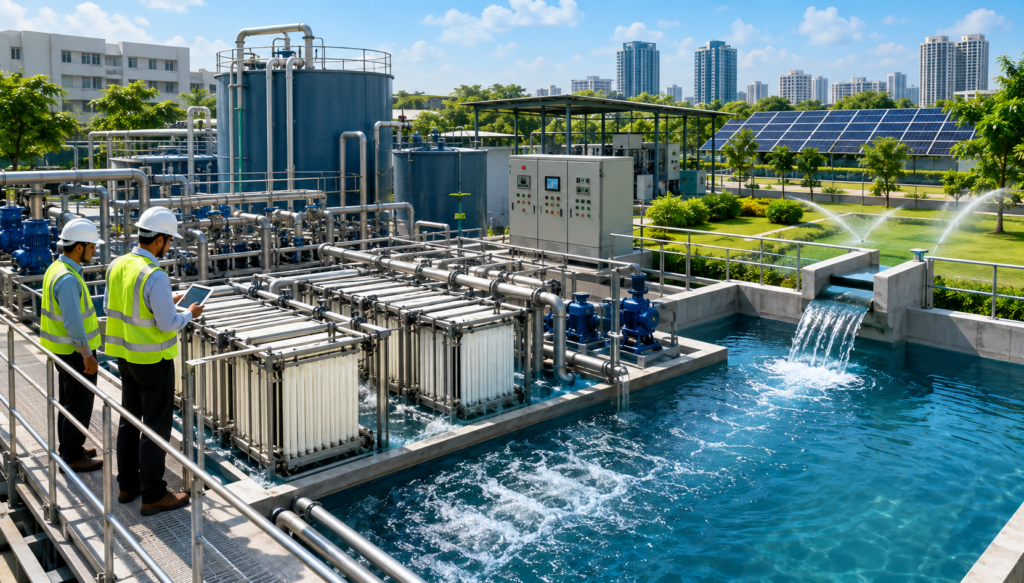
India is facing increasing challenges in wastewater management due to rapid urbanization, industrial growth, population expansion, and growing water scarcity. With stricter environmental regulations and the need for sustainable water reuse, industries, commercial establishments, residential communities, and municipalities are actively seeking advanced wastewater treatment technologies that can deliver superior treatment performance while occupying minimal space.
One technology that has gained significant attention in recent years isMembrane Bioreactor (MBR) Technology. Known for its ability to produce high-quality treated water suitable for reuse, MBR technology combines biological treatment with membrane filtration to achieve exceptional removal of contaminants.
As industries and urban infrastructure projects move toward water conservation and circular water management practices, MBR technology has emerged as one of the most efficient solutions for sewage and wastewater treatment in India.
This comprehensive guide explainswhat MBR technology is, how it works, its benefits, applications, process flow, advantages, limitations, and why it is becoming the preferred wastewater treatment solution in 2026.
What is MBR Technology?
Membrane Bioreactor (MBR) Technology is an advanced wastewater treatment process that combines conventional biological treatment with membrane filtration. Unlike traditional treatment systems that use secondary clarifiers for solid-liquid separation, MBR systems use specialized membranes to separate treated water from biological sludge.
The membranes act as a physical barrier that prevents suspended solids, bacteria, and pathogens from passing through, resulting in highly purified effluent.
Key Features of MBR Technology
- Superior treatment efficiency
- Compact plant footprint
- Excellent treated water quality
- Reduced sludge generation
- Automated operation
- Suitable for water recycling and reuse
- Compliance with stringent environmental norms
Today, MBR technology is widely used in residential, commercial, industrial, and municipal wastewater treatment plants across India.
How Does MBR Technology Work?
MBR systems integrate biological degradation and membrane filtration into a single treatment process.
Step 1: Screening and Pretreatment
Incoming wastewater first passes through screening systems where large debris such as plastics, cloth, paper, and other solids are removed.
Pretreatment may include:
- Bar screens
- Fine screens
- Grit chambers
- Oil and grease traps
This step protects downstream equipment and membranes from damage.
Step 2: Biological Treatment
The screened wastewater enters an aeration tank containing microorganisms.
These microorganisms consume:
- Organic matter
- Suspended solids
- Nutrients
Continuous aeration provides oxygen necessary for biological degradation.
During this process:
- BOD is reduced
- COD is reduced
- Organic pollutants are broken down
- Nutrients are removed
Step 3: Membrane Filtration
This is the heart of an MBR system.
Instead of using conventional clarifiers, wastewater passes through membrane modules.
The membranes retain:
- Activated sludge
- Suspended solids
- Bacteria
- Viruses
- Pathogens
Only clean treated water passes through the membrane pores.
This ensures extremely high effluent quality.
Step 4: Treated Water Collection
The filtered water is collected in treated water tanks.
The water can be reused for:
- Landscaping
- Toilet flushing
- Cooling towers
- Construction activities
- Industrial processes
Step 5: Sludge Handling
Excess biological sludge generated during treatment is periodically removed.
The sludge can undergo:
- Thickening
- Dewatering
- Safe disposal
Compared to conventional systems, MBR technology generally produces less sludge.
Components of an MBR Wastewater Treatment Plant
A typical MBR plant consists of the following major components:
Equalization Tank
Balances flow fluctuations and ensures consistent treatment.
Aeration Tank
Supports biological degradation of contaminants.
Membrane Tank
Contains membrane modules for filtration.
Air Blowers
Supply oxygen and prevent membrane fouling.
Membrane Modules
Perform solid-liquid separation.
Pumps
Transfer wastewater and treated water.
Chemical Cleaning System
Maintains membrane performance.
PLC Control Panel
Automates plant operation and monitoring.
Treated Water Storage Tank
Stores purified water for reuse.
Types of Membranes Used in MBR Systems
Hollow Fiber Membranes
The most commonly used membrane type.
Advantages
- High filtration area
- Compact design
- Energy efficient
- Cost-effective
Applications
- Residential STPs
- Commercial complexes
- Municipal plants
Flat Sheet Membranes
Flat membrane panels mounted in frames.
Advantages
- Easy maintenance
- Longer membrane life
- Reduced fouling
Applications
- Industrial wastewater treatment
- High-strength wastewater
Tubular Membranes
Designed for challenging industrial effluents.
Advantages
- Handles high solids concentrations
- Suitable for difficult wastewater streams
Applications
- Chemical industries
- Food processing industries
Advantages of MBR Technology
Exceptional Treated Water Quality
MBR systems produce crystal-clear effluent with extremely low suspended solids and pathogen content.
This makes treated water suitable for reuse applications.
Compact Plant Design
One of the biggest advantages of MBR technology is its small footprint.
Compared to conventional STPs, MBR plants can reduce land requirements by up to 50%.
This makes them ideal for:
- Apartments
- Hotels
- Hospitals
- IT parks
Superior BOD and COD Removal
Typical removal efficiencies include:
- BOD Removal: >95%
- COD Removal: >90%
- TSS Removal: >99%
Excellent Pathogen Removal
Membranes effectively remove:
- Bacteria
- Viruses
- Pathogens
This significantly improves treated water quality.
Lower Sludge Production
High biomass concentration improves degradation efficiency while reducing sludge generation.
Odor-Free Operation
The closed design minimizes odor issues commonly associated with conventional treatment systems.
Easy Automation
Modern MBR plants can be fully automated using PLC and SCADA systems.
Benefits include:
- Remote monitoring
- Reduced manpower
- Improved operational control
Ideal for Water Reuse
MBR-treated water can be safely reused for numerous non-potable applications, reducing freshwater demand.
Limitations of MBR Technology
Despite its advantages, MBR technology has certain limitations.
Higher Capital Cost
MBR systems require investment in membranes and automation systems.
Membrane Fouling
Over time, membranes accumulate contaminants that reduce performance.
Proper cleaning and maintenance are necessary.
Energy Consumption
Aeration and membrane operation increase power requirements.
Skilled Maintenance
Operators require basic knowledge of membrane maintenance and cleaning procedures.
Applications of MBR Technology in India
Residential Apartments
Large housing societies use MBR plants to recycle wastewater for landscaping and flushing.
Commercial Buildings
Corporate offices and malls benefit from compact, high-performance treatment systems.
Hotels and Resorts
MBR technology enables water reuse while maintaining hygiene standards.
Hospitals
Hospitals require advanced treatment systems capable of removing pathogens and contaminants effectively.
Educational Institutions
Universities and schools increasingly adopt MBR plants for sustainable campus management.
IT Parks
IT campuses use treated water for cooling towers and landscaping.
Pharmaceutical Industries
MBR systems provide high-quality treatment for complex wastewater streams.
Food Processing Industries
Efficient removal of organic pollutants makes MBR ideal for food and beverage applications.
Textile Industries
MBR technology helps achieve water recycling and environmental compliance.
Municipal Sewage Treatment Plants
Urban local bodies increasingly prefer MBR technology for high-quality treated water production.
Industries Using MBR Technology
The following sectors widely adopt MBR wastewater treatment systems:
- Pharmaceutical manufacturing
- Chemical processing
- Food and beverage production
- Dairy industries
- Automobile manufacturing
- Electronics industries
- Textile manufacturing
- Paper and pulp industries
- Power plants
- Industrial parks
MBR vs MBBR vs SBR Technology
Feature | MBR | MBBR | SBR |
Treatment Quality | Excellent | Good | Good |
Water Reuse | Excellent | Moderate | Moderate |
Footprint | Small | Medium | Medium |
Sludge Production | Low | Medium | Medium |
Automation | High | Medium | Medium |
Effluent Quality | Superior | Good | Good |
Capital Cost | High | Moderate | Moderate |
Maintenance | Moderate | Low | Moderate |
MBR is often preferred when high-quality treated water and water reuse are priorities.
Design Considerations for MBR Plants
Several factors influence successful MBR system design.
Wastewater Characteristics
Understanding influent quality is critical.
Parameters include:
- BOD
- COD
- TSS
- Nutrients
- Flow rate
Hydraulic Retention Time (HRT)
Proper HRT ensures effective biological treatment.
Sludge Retention Time (SRT)
Longer SRT enhances biomass activity and treatment efficiency.
Membrane Selection
Choosing the right membrane affects:
- Treatment performance
- Maintenance requirements
- Operating costs
Aeration Requirements
Adequate aeration prevents membrane fouling and supports biological processes.
Operation and Maintenance of MBR Plants
Daily Tasks
- Check blower operation
- Monitor membrane performance
- Inspect pumps
- Verify flow rates
Weekly Tasks
- Inspect membrane modules
- Check sludge levels
- Review treatment efficiency
Monthly Tasks
- Perform membrane cleaning
- Calibrate sensors
- Inspect control systems
Membrane Fouling: Causes and Prevention
Membrane fouling is one of the primary operational challenges.
Common Causes
Biological Fouling
Growth of microorganisms on membrane surfaces.
Organic Fouling
Accumulation of dissolved organic matter.
Inorganic Scaling
Deposition of mineral salts.
Prevention Measures
- Proper pretreatment
- Adequate aeration
- Routine backwashing
- Chemical cleaning
- Process monitoring
Regular maintenance significantly extends membrane life.
Water Quality Achieved by MBR Technology
Typical MBR effluent quality:
Parameter | Influent | Effluent |
BOD | 250–350 mg/L | <10 mg/L |
COD | 500–700 mg/L | <50 mg/L |
TSS | 250–400 mg/L | <5 mg/L |
Turbidity | High | Very Low |
Pathogens | Present | Minimal |
This quality often exceeds regulatory requirements and supports water reuse.
Reuse of Treated Water
One of the strongest advantages of MBR technology is water recycling capability.
Treated water can be used for:
Landscaping
Gardens and green spaces.
Toilet Flushing
Reduces freshwater consumption.
Cooling Towers
Industrial and commercial HVAC systems.
Construction Activities
Concrete mixing and curing.
Industrial Processes
Various manufacturing applications.
Vehicle Washing
Commercial and institutional facilities.
Groundwater Recharge
Subject to local regulations.
Government Guidelines and Compliance in India
Environmental compliance is becoming increasingly important.
MBR systems help organizations comply with:
- CPCB discharge standards
- State Pollution Control Board norms
- Water reuse guidelines
- Environmental clearance requirements
- Sustainable development initiatives
Many industries choose MBR technology specifically to meet stringent treated water quality standards.
Cost of an MBR Wastewater Treatment Plant in India
The cost of an MBR plant depends on several factors:
Plant Capacity
Higher capacities require larger infrastructure.
Membrane Type
Different membrane technologies have varying costs.
Automation Level
Advanced control systems increase investment.
Civil Works
Site-specific construction requirements affect project costs.
Installation and Commissioning
Transportation and installation expenses vary.
Operating Costs
Power consumption, cleaning chemicals, and maintenance influence lifecycle costs.
Although MBR systems require a higher initial investment, the long-term savings from water reuse often justify the expenditure.
Why MBR Technology is the Future of Wastewater Treatment in India
India’s growing focus on sustainability, water conservation, and environmental protection is driving demand for advanced treatment technologies.
MBR technology aligns perfectly with these objectives because it offers:
- High treatment efficiency
- Superior treated water quality
- Minimal footprint
- Reliable operation
- Water recycling capability
- Regulatory compliance
- Reduced environmental impact
As smart cities, industrial parks, residential communities, and municipalities increasingly prioritize water reuse, MBR technology is expected to become one of the most widely adopted wastewater treatment solutions in India.
Conclusion
MBR Technology has transformed wastewater treatment by combining biological treatment with advanced membrane filtration. Its ability to produce high-quality treated water, reduce land requirements, support water reuse, and comply with stringent environmental regulations makes it an ideal choice for modern sewage and wastewater treatment projects.
Whether for residential apartments, commercial buildings, hospitals, industries, or municipal sewage treatment plants,Membrane Bioreactor (MBR) Technology provides a sustainable and future-ready solution for India’s growing wastewater management challenges. As water scarcity concerns continue to rise, investing in MBR wastewater treatment systems will play a crucial role in achieving efficient water recycling, environmental compliance, and long-term sustainability.