
Sewage Treatment Plant Basics: How STP Technology Works
Water is essential for everyday life, but after it is used in homes, apartments, hotels, hospitals, commercial buildings, and industries, it becomes wastewater. This wastewater contains organic matter, suspended solids, detergents, oils, nutrients, and other contaminants that can harm the environment if discharged without proper treatment.
A sewage treatment plant (STP) is a system designed to remove contaminants from sewage and produce treated water suitable for discharge or reuse, depending on its quality and the applicable standards. With increasing urbanisation, water scarcity, and environmental awareness, sewage treatment has become an important part of modern infrastructure.
Today, STP technology includes several treatment methods, such as Moving Bed Biofilm Reactor (MBBR), Sequencing Batch Reactor (SBR), and Membrane Bioreactor (MBR). Each technology has different operating principles, advantages, limitations, and applications.
Understanding the basics of sewage treatment helps building owners, developers, architects, consultants, contractors, and facility managers make informed decisions when planning wastewater treatment systems.
In this guide, we explain what a sewage treatment plant is, how STP technology works, the different types of treatment systems, their benefits, maintenance requirements, and the factors to consider when choosing the right solution for your project.
1. What Is a Sewage Treatment Plant (STP)?
A sewage treatment plant is an engineered facility that treats wastewater generated by human activities before it is discharged into the environment or reused for suitable purposes.
Sewage primarily comes from toilets, bathrooms, kitchens, washing areas, and other domestic activities. Depending on the facility, wastewater may also contain cleaning chemicals, oils, food particles, and other pollutants.
The main purpose of an STP is to reduce pollutants in sewage through physical, biological, and, where required, chemical treatment processes.
Why Is an STP Important?
Untreated sewage can contaminate rivers, lakes, groundwater, and soil. It can also introduce harmful microorganisms and organic pollutants into the environment.
A properly designed and operated STP helps to:
Reduce organic pollution and suspended solids.
Improve wastewater quality before discharge.
Support wastewater recycling and reuse.
Reduce pressure on freshwater resources.
Help facilities meet applicable environmental requirements.
Promote sustainable water management.
STP vs. Water Treatment Plant
An STP and a water treatment plant serve different purposes.
A sewage treatment plant treats wastewater generated by human activities. A water treatment plant (WTP) treats a source of water to make it suitable for its intended use, such as drinking, industrial processes, or other applications.
The treatment process depends on the incoming water quality and the required output quality.
2. How Does STP Technology Work?
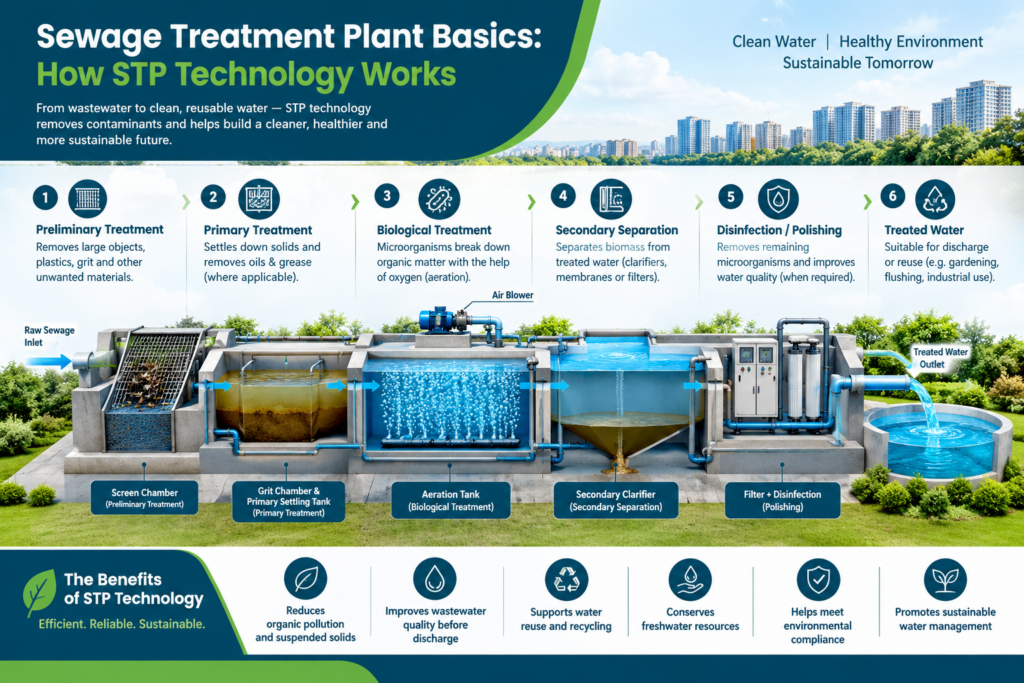
An STP generally treats sewage through a sequence of processes. The exact arrangement depends on the selected technology, the characteristics of the incoming wastewater, the required treated-water quality, and the intended method of discharge or reuse.
Most conventional systems include preliminary treatment, primary treatment where applicable, biological treatment, solids separation, and disinfection or additional polishing when required.
2.1 Preliminary Treatment
Preliminary treatment is the first stage of the sewage treatment process. Its purpose is to remove large objects and materials that could damage equipment or interfere with subsequent treatment stages.
Sewage may contain plastic, cloth, sanitary waste, paper, grit, sand, and other unwanted materials.
Screens remove larger solids, while grit-removal equipment may separate sand and heavier inorganic particles. Pumps and other equipment can then operate more reliably.
Effective preliminary treatment helps prevent blockages, reduces equipment wear, and improves the overall performance of the treatment plant.
2.2 Primary Treatment
Primary treatment generally involves separating settleable solids and floating materials from wastewater.
In a primary settling tank, heavier suspended particles settle to the bottom, while oils and grease may float to the surface and be removed. The settled material is collected as sludge.
Not every STP requires a separate primary settling tank. Some compact systems and biological treatment configurations combine or modify treatment stages to suit the application.
The main objective is to reduce the solids and pollutant load entering the next treatment stage.
2.3 Biological Treatment
Biological treatment is one of the most important stages of an STP.
Sewage contains organic pollutants that can be broken down by microorganisms under controlled conditions. These microorganisms consume biodegradable organic matter and convert it into simpler substances, new biological growth, and other products of the treatment process.
Many biological systems use aeration to supply oxygen to microorganisms. Air is introduced through blowers and diffusers or other aeration equipment.
The amount of oxygen supplied, the wastewater characteristics, the biological loading, and the operating conditions all influence treatment performance.
Different STP technologies manage this biological process in different ways. MBBR uses biofilm carriers, SBR operates in timed treatment cycles, and MBR combines biological treatment with membrane separation.
Selecting the right biological process is essential for achieving reliable treatment while managing energy consumption, space requirements, and maintenance.
2.4 Solids Separation
After biological treatment, the wastewater may contain biological solids known as biomass.
These solids must be separated from the treated water. The separation method depends on the selected STP technology.
Conventional activated-sludge systems commonly use a secondary clarifier, where biological solids settle and clarified water flows out. Some of the settled biomass may be returned to the biological treatment tank.
MBBR systems may also use a clarifier or another suitable solids-separation arrangement. MBR systems use membranes to separate suspended solids from the treated water.
Proper solids separation helps reduce suspended solids in the final effluent and supports consistent treatment performance.
2.5 Tertiary Treatment and Disinfection
Tertiary treatment provides additional treatment when the intended reuse or discharge requirements demand it.
Depending on the application, this stage may include filtration, activated carbon treatment, nutrient removal, or other polishing processes.
Disinfection may be carried out using suitable methods such as ultraviolet (UV) treatment or chlorination. The choice depends on the required microbial quality, water reuse application, operating conditions, and applicable standards.
For example, treated water intended for toilet flushing or landscaping may require additional treatment and disinfection beyond the biological treatment stage.
It is important to remember that treated sewage water is not automatically suitable for drinking. Potable reuse requires a specifically designed treatment system, appropriate validation, and compliance with relevant health and regulatory requirements.
2.6 Sludge Management
Sludge is generated as solids are separated during wastewater treatment. It may contain organic matter, microorganisms, and other substances removed from the wastewater.
Sludge management is an essential part of STP operation.
Depending on the system, sludge may undergo thickening, stabilisation, dewatering, and appropriate disposal or further processing.
Equipment such as filter presses or screw presses can reduce the water content of sludge and decrease its volume, making handling and transportation easier.
The sludge must be managed in accordance with its characteristics and applicable regulations. Poor sludge management can cause odour problems, operational difficulties, and environmental risks.
3. Different Types of STP Technologies
Different sewage treatment technologies are available to meet the needs of residential, commercial, industrial, and municipal projects.
The best option depends on factors such as sewage quantity, wastewater characteristics, available space, treated-water requirements, operating costs, and maintenance capabilities.
3.1 MBBR Technology
MBBR stands for Moving Bed Biofilm Reactor. It is a biological treatment technology that uses specially designed plastic carriers inside a treatment tank.
Microorganisms grow on the surface of these carriers and form a biological layer called a biofilm. As the carriers move within the tank, the biofilm comes into contact with wastewater and, in aerobic applications, supplied oxygen.
This enables microorganisms to break down organic pollutants.
Key advantages of MBBR include:
Efficient use of biological treatment volume.
Relatively compact design for suitable applications.
No requirement for conventional biomass return solely to maintain the carrier biofilm.
Flexibility for new installations and certain plant upgrades.
Potential to handle variations in wastewater loading when properly designed.
However, MBBR systems still require suitable aeration, solids separation, process monitoring, and routine maintenance. Carrier retention screens and aeration equipment must also be maintained.
MBBR is commonly considered for residential developments, hotels, commercial buildings, and other facilities requiring biological wastewater treatment.
3.2 SBR Technology
SBR stands for Sequencing Batch Reactor. It treats wastewater in a tank through a series of controlled operating phases rather than relying on separate tanks for every treatment step.
A typical SBR cycle includes filling, biological reaction, settling, and treated-water decanting. Some systems also include idle periods or additional process phases.
During the reaction stage, microorganisms break down organic pollutants. Aeration and mixing are controlled according to the process requirements. During settling, the biomass separates from the water, allowing treated water to be removed.
Key advantages of SBR include:
Multiple treatment phases within a common tank.
Flexible control over reaction and settling periods.
Potential for nutrient removal when appropriately designed and operated.
Reduced need for certain separate process tanks.
Suitability for applications where batch-based operation is practical.
SBR systems require suitable automation, process controls, and cycle management. Their performance depends on proper operating sequences, loading conditions, and reliable equipment.
They are commonly used in residential communities, institutional buildings, commercial facilities, and municipal wastewater treatment applications.
3.3 MBR Technology
MBR stands for Membrane Bioreactor. It combines biological wastewater treatment with membrane filtration.
Microorganisms break down biodegradable pollutants, while membranes separate suspended solids and biomass from the treated water. Depending on the membrane configuration, filtration is commonly achieved using microfiltration or ultrafiltration membranes.
Because the membranes provide effective solids separation, MBR systems can produce water with low suspended-solids concentrations when properly designed and operated.
Key advantages of MBR include:
High-quality solids separation.
Compact system design for many applications.
Potential suitability for water reuse requiring advanced treatment.
Reduced dependence on conventional secondary clarification.
Ability to maintain relatively high biomass concentrations.
MBR systems also have considerations such as membrane fouling, cleaning requirements, membrane replacement costs, and energy consumption. Additional treatment or disinfection may still be necessary for the intended reuse.
MBR is often considered for projects where space is limited or where treated-water quality requirements justify the additional equipment and operating complexity.
3.4 Compact and Johkasou-Based STP Systems
Compact sewage treatment systems are designed to treat wastewater within a relatively small footprint, making them useful for selected residential and commercial applications.
Some compact systems use Johkasou-based treatment concepts originating in Japan. These systems can integrate multiple treatment stages within a packaged unit, depending on the design.
Potential advantages include simplified installation, reduced space requirements, and standardised equipment arrangements. Actual performance depends on plant capacity, wastewater characteristics, system design, installation quality, and maintenance practices.
Compact STPs may be suitable for villas, hotels, apartment buildings, institutions, and other projects where conventional treatment arrangements are difficult to accommodate.
Before selecting a compact STP, project owners should verify its treatment capacity, applicable approvals, operating requirements, and ability to meet the required treated-water standards.
4. Key Components of a Sewage Treatment Plant
An STP consists of several interconnected components that work together to treat wastewater.
Collection and equalisation tanks: These collect incoming sewage and, where required, balance variations in flow and pollutant concentration.
Screens and grit-removal equipment: These remove unwanted solids and heavier particles before they reach sensitive equipment.
Pumps and piping: These transfer wastewater, sludge, and treated water between different treatment stages.
Aeration blowers and diffusers: These supply oxygen to aerobic biological processes. Their sizing and operation influence treatment performance and electricity consumption.
Biological treatment tanks: These provide the conditions required for microorganisms to break down organic pollutants.
Clarifiers or membrane systems: These separate biological solids from treated wastewater.
Disinfection equipment: This reduces microbial contamination when required for discharge or reuse.
Sludge-handling equipment: This collects, processes, and dewaters sludge for appropriate management.
Electrical panels and automation systems: These control pumps, blowers, valves, and other equipment. Advanced systems may also include alarms, sensors, remote monitoring, and process data recording.
The selection and sizing of these components should be based on sound engineering calculations rather than capacity alone.
5. What Are the Benefits of Installing an STP?
Installing a properly designed and maintained sewage treatment plant offers environmental, operational, and water-management benefits.
Reduces Water Pollution
An STP reduces organic pollutants, suspended solids, and other contaminants through appropriate treatment processes. This helps limit the environmental impact of wastewater discharge.
Supports Water Reuse
Treated wastewater can replace freshwater for suitable non-potable applications, including landscaping, toilet flushing, and certain industrial uses, provided the water quality meets the requirements for the intended use.
Conserves Freshwater Resources
Reusing treated wastewater can reduce demand on municipal supplies and groundwater sources. This is particularly valuable in water-stressed regions and large residential or commercial developments.
Supports Environmental Compliance
Many facilities must meet specific wastewater treatment and discharge requirements. A properly selected and operated STP helps facilities work towards compliance with the standards and consent conditions applicable to their location and project.
Compliance depends on the required parameters, sampling, monitoring, plant performance, and relevant approvals.
Can Reduce Long-Term Water Costs
Where treated water is reused effectively, facilities may reduce freshwater purchases and associated expenses. Actual savings depend on treatment costs, energy use, water demand, and the availability of suitable reuse applications.
Improves Sustainable Building Management
An STP supports responsible wastewater management and can form an important part of a building’s sustainability strategy.
6. Where Are Sewage Treatment Plants Used?
STPs are used in a wide range of applications, with treatment requirements varying according to occupancy, wastewater characteristics, and intended reuse.
Residential apartments and gated communities: These generate sewage from toilets, bathrooms, kitchens, and common facilities. Treatment and reuse can support landscaping and other suitable non-potable applications.
Hotels and resorts: Wastewater generation may vary with occupancy, kitchens, laundry operations, and seasonal demand. The STP must be designed to handle these variations.
Hospitals and healthcare facilities: These may require careful wastewater characterisation and additional treatment considerations depending on the wastewater streams and applicable requirements.
Schools and educational institutions: Treatment capacity depends on student numbers, staff, kitchens, hostels, and other facilities.
Commercial buildings and IT parks: These facilities may benefit from planned wastewater reuse for toilet flushing, landscaping, and other appropriate applications.
Industrial facilities: Treatment requirements depend on the type of industry. Industrial wastewater may require pretreatment or a specialised effluent treatment plant (ETP) rather than a standard domestic sewage treatment system.
Municipal projects: Municipal STPs treat sewage collected from larger service areas and require capacity planning, process control, sludge management, and long-term operational support.
Each application requires an assessment of flow, wastewater characteristics, site conditions, and discharge or reuse objectives.
7. What Happens to Water After Sewage Treatment?
After treatment, the resulting water is commonly called treated effluent or treated wastewater.
Its quality depends on the treatment technology, operating conditions, incoming sewage, and any additional filtration or disinfection stages.
When the quality is appropriate, treated wastewater may be used for:
Gardening and landscaping.
Toilet flushing.
Road cleaning and other approved municipal applications.
Certain industrial processes.
Cooling applications where the water chemistry and microbiological quality are suitable.
Not every treated-water output is suitable for every application. For example, industrial cooling may require additional control of hardness, salts, scaling potential, and biological growth.
Likewise, treated water intended for toilet flushing or public landscaping may need additional disinfection and monitoring.
A wastewater reuse plan should identify the intended applications, the required water quality, the storage and distribution arrangements, and measures to prevent cross-connections with potable water systems.
8. How to Choose the Right STP for Your Project
Choosing an STP involves more than comparing equipment prices. The treatment system must match the project’s actual needs and remain practical to operate over its service life.
8.1 Estimate Sewage Generation
Begin by estimating daily sewage generation based on occupancy, water consumption, facility type, and applicable design criteria.
For residential projects, the number of apartments and occupants is important. For hotels, room occupancy, kitchens, laundry, and other facilities may affect the sewage load.
The design should also consider peak flows and future expansion where relevant.
8.2 Evaluate Available Space
The available land or plant room may influence the choice of treatment technology.
Compact systems can be useful where space is restricted, while larger sites may accommodate different process configurations.
Consider not only the treatment tanks but also access for maintenance, sludge handling, ventilation, equipment replacement, and treated-water storage.
8.3 Compare Operating Costs
Review electricity consumption, maintenance, consumables, sludge disposal, and the expected service life of major components.
Blowers and pumps can contribute significantly to operating costs. Equipment efficiency, control strategies, and appropriate process design can help improve overall performance.
8.4 Assess Maintenance Requirements
Every STP needs inspection and maintenance. The frequency and complexity depend on its design and equipment.
Consider the availability of trained operators, service support, spare parts, and remote monitoring.
A system with simplified operation may be particularly useful where dedicated technical staff are not readily available. However, simplified operation does not eliminate the need for inspections and performance checks.
8.5 Check Treated-Water Requirements
Identify whether the treated water will be discharged or reused. This determines the treatment quality required and whether additional filtration, disinfection, or other processes are necessary.
Confirm applicable regulatory requirements before finalising the design.
8.6 Review Automation and Monitoring
Automation can help manage operating cycles, control equipment, record data, and provide alarms when abnormal conditions occur.
Depending on the application, monitoring may include flow, pH, dissolved oxygen, and other relevant parameters. Online monitoring requirements vary by project and applicable regulations.
8.7 Select an Experienced Engineering Partner
An experienced wastewater engineering company can help assess site conditions, select suitable technology, prepare design calculations, coordinate installation, and provide commissioning and after-sales support.
The objective should be a reliable treatment solution that meets the project’s performance requirements and can be maintained throughout its operating life.
9. Common STP Problems and Maintenance Tips
Even a well-designed STP can experience problems if it is overloaded, incorrectly operated, or poorly maintained.
Unpleasant Odours
Odours may result from septic conditions, accumulated sludge, inadequate aeration, or poor ventilation.
Maintenance tip: Inspect the collection and treatment tanks, check aeration and flow conditions, and remove accumulated solids as required.
Poor Treated-Water Quality
High suspended solids, excessive organic pollutants, or inconsistent effluent quality can indicate process imbalance, equipment failure, hydraulic overloading, or ineffective solids separation.
Maintenance tip: Monitor relevant water-quality parameters, inspect treatment equipment, and investigate the underlying cause before making operational changes.
Excessive Foam or Sludge
Foam and abnormal sludge behaviour may be associated with wastewater composition, biological conditions, detergents, or process imbalances.
Maintenance tip: Examine operating conditions and wastewater characteristics. Avoid adding chemicals without understanding the cause and their effect on the biological process.
Equipment Breakdown
Pump, blower, valve, and control-panel failures can interrupt treatment.
Maintenance tip: Follow a preventive maintenance schedule, inspect equipment regularly, and maintain essential spare parts where appropriate.
High Electricity Consumption
Excessive energy use can result from inefficient equipment, unnecessary operation, incorrect control settings, or process problems.
Maintenance tip: Review blower and pump operation, check for leaks or blockages, and optimise equipment operation without compromising treatment performance.
Poor Sludge Management
Excess sludge accumulation can reduce tank capacity and affect treatment performance.
Maintenance tip: Monitor sludge accumulation, arrange periodic removal or dewatering, and ensure the resulting sludge is handled and disposed of appropriately.
Routine inspections, documented maintenance, trained personnel, and periodic performance testing help improve STP reliability.
10. STP Installation and Operating Costs
The cost of installing and operating an STP varies considerably from one project to another. There is no single price that applies to every sewage treatment plant.
Factors Affecting Installation Costs
The main factors include:
Required treatment capacity, usually expressed in KLD or MLD.
Selected technology and treatment configuration.
Civil works, excavation, foundations, and tank construction.
Mechanical equipment, pumps, blowers, and piping.
Electrical panels, automation, and monitoring systems.
Filtration, disinfection, and treated-water storage requirements.
Site access, installation complexity, and commissioning.
Sludge-handling and disposal arrangements.
A compact packaged STP may have different installation requirements from a conventional system built with extensive civil structures.
Factors Affecting Operating Costs
Operating expenses may include electricity, labour, maintenance, replacement parts, chemicals, laboratory testing, membrane replacement where applicable, and sludge handling.
A system with a lower purchase price may not always have the lowest lifetime cost. Similarly, advanced technology may justify its additional cost when it provides necessary treated-water quality or space savings.
When evaluating proposals, compare the complete scope of supply, guaranteed performance parameters, energy requirements, maintenance arrangements, and expected operating expenses.
A lifecycle cost assessment can help identify the most appropriate solution for the project.
11. Frequently Asked Questions About Sewage Treatment Plants
What is the main purpose of a sewage treatment plant?
The main purpose of an STP is to remove contaminants from sewage so the treated water can be safely discharged or reused for suitable applications in accordance with applicable requirements.
How does an STP work?
An STP typically uses physical separation, biological treatment, solids removal, and, where required, additional filtration and disinfection. The exact process depends on the selected technology and the required treated-water quality.
Which STP technology is best for apartments?
MBBR, SBR, MBR, and compact treatment systems may all be suitable for apartment projects. The right choice depends on sewage generation, space availability, treated-water requirements, operating costs, and maintenance capabilities.
A project-specific assessment is recommended before choosing a system.
How much space is required for an STP?
Space requirements depend on treatment capacity, technology, tank arrangement, equipment, access requirements, and additional facilities such as sludge dewatering and treated-water storage.
Compact technologies may reduce the footprint, but the final space requirement should be confirmed through engineering design.
Can treated sewage water be reused?
Yes. Properly treated wastewater can be reused for suitable applications such as landscaping, toilet flushing, and certain industrial uses when its quality meets the requirements for that purpose.
Does an STP require daily operation and maintenance?
STPs require regular monitoring and maintenance. Depending on the design, some systems need frequent operator attention, while automated systems can reduce routine manual intervention.
Automation does not remove the need for inspections, servicing, sludge management, and water-quality monitoring.
How is STP capacity calculated?
STP capacity is estimated from expected sewage generation, occupancy, water consumption, facility type, and design criteria. The design should also consider flow variations and the wastewater characteristics.
The final capacity should be determined through an appropriate engineering assessment.
What is the difference between MBBR, SBR, and MBR?
MBBR uses microorganisms growing on moving biofilm carriers. SBR treats wastewater through timed operating phases in a reactor. MBR combines biological treatment with membrane filtration to separate solids from treated water.
Each technology has different space, energy, maintenance, and performance considerations.
Is an STP mandatory for every building?
Requirements depend on the building type, size, location, applicable regulations, and project approvals. Developers should confirm the requirements with the relevant authorities and qualified engineering professionals.
12. Conclusion: Choosing the Right STP Technology
Sewage treatment plants play an important role in wastewater management, pollution prevention, and water conservation. By removing contaminants from sewage, an STP can help protect the environment and support the reuse of treated wastewater for suitable applications.
Understanding the basics of STP technology makes it easier to compare treatment methods and evaluate project requirements. MBBR, SBR, MBR, and compact treatment systems each offer potential benefits, but no single technology is ideal for every application.
The right solution depends on sewage generation, available space, required treated-water quality, operating costs, maintenance needs, and applicable environmental standards.
A reliable STP is not defined by technology alone. Proper engineering, quality equipment, correct installation, commissioning, and ongoing maintenance are equally important for long-term performance.
For residential developments, commercial buildings, industrial facilities, and municipal projects, choosing an experienced wastewater engineering partner can help ensure that the treatment system is suited to the site and its operating requirements.
Looking for the Right Sewage Treatment Plant for Your Project?
GreenSew provides wastewater engineering solutions for residential, commercial, industrial, and municipal applications. Our range of sewage treatment technologies can be evaluated according to project capacity, site conditions, treated-water requirements, and operational needs.
Whether you are planning a new STP installation, upgrading an existing facility, or exploring wastewater reuse, the right engineering approach can help improve treatment reliability and support more responsible water management.
Sewage water recycling and reuse
GreenSew project portfolio
Contact GreenSew for STP requirements
 Previous Post
 Next Post
