
Sewage Treatment Plant in Hyderabad | Best STP Manufacturer, Supplier & Installation Services
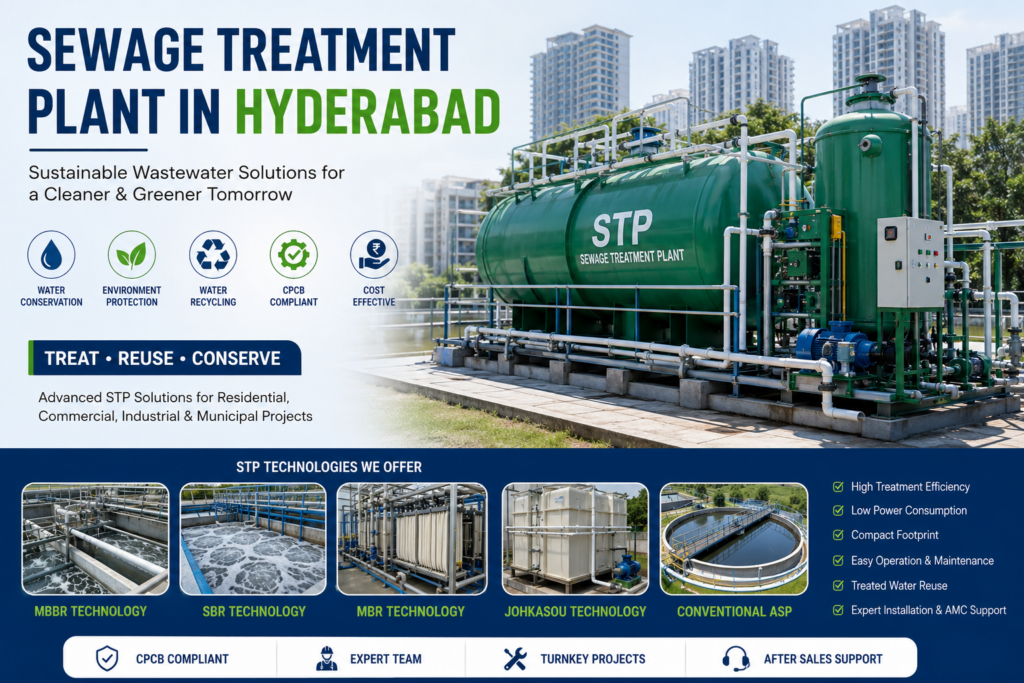
Hyderabad has emerged as one of India’s fastest-growing metropolitan cities, with rapid expansion in residential townships, commercial complexes, IT parks, healthcare facilities, educational institutions, and manufacturing industries. While this growth has significantly contributed to economic development, it has also increased the demand for efficient wastewater management solutions. As freshwater resources become increasingly scarce, treating and reusing wastewater is no longer an option—it is a necessity.
ASewage Treatment Plant in Hyderabad plays a vital role in protecting the environment by treating domestic and industrial wastewater before it is discharged or reused. Modern STPs help reduce water pollution, conserve freshwater, and ensure compliance with environmental regulations issued by the Central Pollution Control Board (CPCB) and the Telangana Pollution Control Board (TGPCB).
Whether you are a builder developing an apartment complex, an industrial owner managing wastewater, a hospital administrator, or a municipal authority, choosing the rightSTP manufacturer in Hyderabad is essential for long-term operational efficiency and sustainability.
In this comprehensive guide, you’ll learn everything about sewage treatment plants in Hyderabad, including how they work, the latest treatment technologies, government regulations, costs, applications, and how to choose the best supplier for your project.
What is a Sewage Treatment Plant (STP)?
ASewage Treatment Plant (STP) is a wastewater treatment system designed to remove contaminants, organic matter, suspended solids, harmful bacteria, and pollutants from sewage generated by homes, apartments, commercial buildings, industries, and institutions.
The treated water can be safely reused for various non-potable applications such as:
- Landscape irrigation
- Toilet flushing
- Cooling towers
- Construction activities
- Gardening
- Floor cleaning
- Industrial processes
Instead of allowing untreated sewage to contaminate lakes, rivers, and groundwater, an STP converts wastewater into reusable water through a series of physical, biological, and chemical treatment processes.
Why is an STP Important?
Installing aSewage Treatment Plant in Hyderabad offers numerous environmental and economic benefits:
- Reduces environmental pollution
- Conserves freshwater resources
- Enables water recycling and reuse
- Ensures compliance with CPCB and TGPCB regulations
- Supports sustainable urban development
- Reduces dependence on freshwater supply
- Improves public health by preventing water contamination
Why Hyderabad Needs Sewage Treatment Plants
Hyderabad’s population continues to grow due to rapid urbanization and industrial development. Thousands of new residential apartments, gated communities, commercial spaces, educational institutions, pharmaceutical companies, and IT campuses generate large volumes of wastewater every day.
Without proper treatment, untreated sewage can:
- Pollute lakes and rivers
- Contaminate groundwater
- Cause foul odours
- Spread harmful diseases
- Damage ecosystems
- Lead to regulatory penalties
Key Reasons STPs Are Essential in Hyderabad
1. Rapid Urban Development
Hyderabad has witnessed continuous infrastructure growth in areas such as Gachibowli, Kokapet, Financial District, Kondapur, Miyapur, Kompally, Shamshabad, Uppal, and Tellapur. Every new development increases wastewater generation, makingresidential sewage treatment plants in Hyderabad essential.
2. Water Scarcity
Although Hyderabad receives seasonal rainfall, water shortages remain a concern. Reusing treated wastewater for landscaping, flushing, and cooling systems significantly reduces freshwater consumption.
3. Environmental Protection
Untreated sewage adversely affects lakes, rivers, and groundwater. Installingwastewater treatment plants in Hyderabad helps preserve natural ecosystems and improves environmental sustainability.
4. Government Compliance
Environmental authorities require many residential, commercial, and industrial projects to install sewage treatment systems before receiving operational approvals.
5. Sustainable Water Management
Modern STPs support Hyderabad’s vision of becoming a sustainable smart city by promoting wastewater recycling and reducing dependence on freshwater sources.
Government Regulations for Sewage Treatment Plants in Hyderabad
Every commercial, industrial, and large residential project should comply with applicable environmental norms for wastewater treatment.
CPCB Guidelines
The Central Pollution Control Board (CPCB) has established discharge standards to ensure treated wastewater does not harm the environment.
Typical parameters include:
- Biological Oxygen Demand (BOD)
- Chemical Oxygen Demand (COD)
- Total Suspended Solids (TSS)
- pH
- Oil & Grease
- Ammoniacal Nitrogen
Meeting these standards ensures treated water is suitable for reuse or safe discharge, depending on the applicable regulations.
Telangana Pollution Control Board (TGPCB)
The Telangana Pollution Control Board oversees wastewater management within the state and may require eligible projects to install approved sewage treatment systems and comply with monitoring and reporting requirements.
Benefits of Regulatory Compliance
- Faster project approvals
- Reduced environmental impact
- Improved corporate reputation
- Lower risk of penalties
- Sustainable business operations
Types of Sewage Treatment Plants in Hyderabad
Several technologies are available for sewage treatment. Choosing the right one depends on wastewater characteristics, available space, budget, maintenance requirements, and reuse objectives.
1. MBBR (Moving Bed Biofilm Reactor)
MBBR technology uses specially designed bio-media suspended inside the treatment tank. Beneficial microorganisms grow on these media and efficiently degrade organic pollutants.
Advantages
- Compact footprint
- High treatment efficiency
- Easy operation
- Low maintenance
- Suitable for residential and industrial projects
Applications
- Apartments
- Hotels
- Hospitals
- Educational institutions
- Industries
2. MBR (Membrane Bioreactor)
MBR combines biological treatment with membrane filtration to produce high-quality treated water suitable for reuse.
Benefits
- Excellent treated water quality
- Very low suspended solids
- Minimal footprint
- Ideal where water reuse is a priority
3. SBR (Sequencing Batch Reactor)
SBR treats wastewater in timed treatment cycles within a single reactor, combining aeration, settling, and decanting.
Advantages
- High treatment performance
- Flexible operation
- Suitable for varying sewage loads
- Lower sludge generation
4. Johkasou Technology
Johkasou is a compact packaged sewage treatment system originally developed in Japan. It is widely recognized for its efficient biological treatment, small footprint, and ease of installation.
Key Features
- Plug-and-play design
- Factory-built system
- Compact installation
- Low power consumption
- Minimal maintenance
- Suitable for space-constrained projects
Best Applications
- Villas
- Small apartments
- Resorts
- Schools
- Commercial buildings
5. Conventional Activated Sludge Process (ASP)
ASP is one of the oldest sewage treatment methods and is commonly used in large municipal treatment plants.
Suitable For
- Large municipalities
- Industrial townships
- High-capacity treatment plants
Although effective, ASP generally requires larger land areas and higher operational attention compared to compact packaged systems.
How Does a Sewage Treatment Plant Work?
Understanding the treatment process helps project owners choose the right technology and appreciate the importance of each treatment stage.
A typicalSewage Treatment Plant in Hyderabad follows these stages:
Step 1: Screening
Large objects such as plastic, paper, cloth, and debris are removed to protect downstream equipment.
Step 2: Equalization Tank
Wastewater flow is balanced to maintain consistent hydraulic loading and improve treatment efficiency.
Step 3: Biological Treatment
Beneficial microorganisms consume dissolved organic matter, reducing pollution levels.
Step 4: Secondary Clarification
Biological solids settle naturally, separating treated water from sludge.
Step 5: Filtration
Pressure sand filters and activated carbon filters help remove fine suspended particles and residual impurities.
Step 6: Disinfection
Chlorination, UV treatment, or other disinfection methods help reduce harmful microorganisms before reuse or discharge.
Step 7: Treated Water Storage
The treated water is collected in a storage tank for reuse in suitable non-potable applications.
Step 8: Sludge Handling
Settled sludge is periodically removed and processed for safe disposal or further treatment.
Applications, Benefits, Capacity Selection & Cost Guide
Applications of Sewage Treatment Plants in Hyderabad
With Hyderabad’s rapid urbanization, wastewater treatment has become a critical requirement across multiple sectors. A modernSewage Treatment Plant (STP) ensures that wastewater is treated efficiently and safely reused, reducing environmental pollution and conserving valuable freshwater resources.
1. Residential Apartments & Gated Communities
Residential complexes generate a significant amount of sewage daily from bathrooms, kitchens, laundries, and toilets. Installing aResidential Sewage Treatment Plant in Hyderabad enables treated water to be reused for:
- Landscape irrigation
- Toilet flushing
- Car washing
- Garden watering
- Floor cleaning
This not only reduces freshwater consumption but also lowers monthly water bills and supports sustainable living.
2. Villas & Luxury Housing Projects
Independent villas and premium residential communities increasingly prefercompact packaged STPs due to their:
- Space-saving design
- Quiet operation
- Low maintenance
- Minimal power consumption
- Easy installation
3. Commercial Buildings
Office buildings, shopping malls, business parks, and retail complexes consume large quantities of water daily.
ACommercial Sewage Treatment Plant in Hyderabad helps businesses:
- Recycle wastewater
- Reduce operational costs
- Meet environmental regulations
- Improve sustainability ratings
4. Hotels & Resorts
Hotels produce wastewater from guest rooms, kitchens, laundries, restaurants, and swimming pools.
Benefits include:
- Continuous water recycling
- Reduced freshwater demand
- Lower utility expenses
- Environmentally responsible operations
5. Hospitals & Healthcare Facilities
Hospitals require reliable wastewater treatment systems to maintain hygiene and comply with environmental standards.
ModernHospital Sewage Treatment Plants are designed to:
- Handle variable wastewater loads
- Reduce harmful contaminants
- Support safe water reuse
- Ensure regulatory compliance
6. Educational Institutions
Schools, colleges, universities, and hostels generate significant wastewater every day.
Installing an STP helps institutions:
- Promote sustainability
- Reduce water costs
- Reuse treated water for gardening and flushing
- Demonstrate environmental responsibility
7. Industrial Facilities
Industrial wastewater often requires specialized treatment depending on the type of manufacturing process.
Industries in Hyderabad useIndustrial Sewage Treatment Plants to:
- Meet pollution control norms
- Reduce environmental impact
- Recycle treated water
- Improve operational efficiency
8. Municipal Projects
Municipal corporations install large-capacity STPs to:
- Treat community wastewater
- Protect lakes and rivers
- Improve public sanitation
- Support sustainable urban infrastructure
Benefits of Installing a Sewage Treatment Plant
Investing in aSewage Treatment Plant in Hyderabad provides both environmental and financial advantages.
Water Conservation
Water scarcity is becoming a major concern across India. Recycling treated wastewater significantly reduces dependence on freshwater resources.
Lower Water Bills
Reusing treated water for flushing, landscaping, and cooling systems helps reduce water procurement costs.
Environmental Protection
Proper sewage treatment prevents pollution of:
- Rivers
- Lakes
- Groundwater
- Agricultural land
Regulatory Compliance
A CPCB-compliant STP helps organizations meet environmental regulations and avoid penalties.
Improved Corporate Image
Businesses adopting sustainable wastewater treatment demonstrate environmental responsibility, strengthening their brand reputation.
Compact Design
Modern packaged STPs require much less space compared to conventional treatment plants, making them ideal for urban developments.
Energy Efficiency
Advanced technologies such as Johkasou, MBBR, and SBR consume less electricity than traditional treatment systems, helping reduce operating costs.
Low Maintenance
Automated systems reduce the need for constant operator supervision and simplify routine maintenance.
Odour-Free Operation
Well-designed STPs minimize unpleasant odours through efficient biological treatment and proper aeration.
Long Service Life
Quality equipment, corrosion-resistant materials, and preventive maintenance contribute to reliable long-term performance.
STP Capacity Selection Guide
Selecting the correct STP capacity is essential for efficient operation and future expansion.
Capacity Recommendations
Project Type | Recommended Capacity |
Individual Villa | 5–15 KLD |
Small Apartment | 20–50 KLD |
Medium Apartment | 50–150 KLD |
Large Apartment | 150–500 KLD |
Commercial Complex | 20–300 KLD |
Hotel | 30–300 KLD |
Hospital | 25–500 KLD |
School / College | 20–250 KLD |
Industrial Facility | 50–1000+ KLD |
Municipality | 500 KLD and above |
Tip: Always estimate future occupancy and water demand when sizing an STP to avoid under-capacity issues.
Factors Affecting Sewage Treatment Plant Cost in Hyderabad (2026)
The cost of an STP depends on several technical and project-specific factors rather than a single fixed price.
1. Treatment Capacity
Higher-capacity plants require larger tanks, pumps, blowers, piping, and automation systems.
2. Treatment Technology
Different technologies have different capital and operating costs.
- MBBR
- MBR
- SBR
- Johkasou
- Activated Sludge Process
The choice depends on space availability, effluent quality requirements, and maintenance preferences.
3. Tank Material
The material used for construction influences durability, transportation, and installation costs.
Common options include:
- FRP (Fiber Reinforced Plastic)
- Mild Steel (MS)
- Reinforced Cement Concrete (RCC)
- Stainless Steel (for specific applications)
4. Automation Level
Fully automated STPs reduce manual intervention but may involve higher initial investment.
5. Civil Works
Costs vary depending on:
- Excavation
- Foundation
- RCC structures
- Piping
- Electrical installations
6. Installation Location
Transportation, site accessibility, and local conditions can affect installation costs.
7. Water Quality Requirements
Projects requiring higher treated water quality for reuse may require additional filtration or advanced treatment systems.
8. Operation & Maintenance
Long-term operating costs depend on:
- Power consumption
- Spare parts
- Sludge removal
- Preventive maintenance
- AMC (Annual Maintenance Contract)
Choosing an energy-efficient STP can significantly reduce lifetime operating expenses.
Why Packaged Sewage Treatment Plants Are Becoming Popular
ModernPackaged Sewage Treatment Plants in Hyderabad are increasingly preferred because they are factory-built, easy to install, and require less space than conventional systems.
Key Advantages
- Factory-tested before delivery
- Quick installation
- Compact footprint
- Minimal civil work
- Easy transportation
- Plug-and-play operation
- Low maintenance
- Energy efficient
- Scalable for future expansion
These systems are ideal for residential apartments, villas, schools, hotels, hospitals, and commercial buildings where space and installation time are critical.
Latest Trends in Sewage Treatment Technology (2026)
The wastewater treatment industry continues to evolve with advanced technologies focused on sustainability and operational efficiency.
Smart Automation
- PLC-based controls
- Remote monitoring
- Alarm notifications
- Automated operation
Energy-Efficient Systems
Modern blowers, pumps, and diffusers reduce electricity consumption while maintaining high treatment performance.
Water Reuse
Treated wastewater is increasingly reused for:
- Landscaping
- Industrial cooling
- Toilet flushing
- Construction
- Gardening
Compact Modular Designs
Packaged STPs are designed for faster deployment and easier maintenance, making them suitable for urban projects with limited space.
How to Choose the Best Sewage Treatment Plant Manufacturer in Hyderabad
Selecting the rightSewage Treatment Plant manufacturer in Hyderabad is one of the most important decisions for the long-term success of your project. A well-designed STP not only ensures compliance with environmental regulations but also minimizes operating costs, reduces maintenance, and delivers reliable performance for years.
Here are the key factors to consider:
1. Industry Experience
Choose a manufacturer with extensive experience in designing, manufacturing, and installing sewage treatment plants for residential, commercial, industrial, and municipal projects.
An experienced company understands local regulations, wastewater characteristics, and project-specific requirements.
2. Proven Project Portfolio
Review the company’s completed projects across different sectors, such as:
- Apartments
- Villas
- Hospitals
- Hotels
- IT Parks
- Educational Institutions
- Industries
- Government Projects
A strong portfolio demonstrates technical expertise and reliability.
3. Advanced Treatment Technologies
A reputable manufacturer should offer multiple treatment technologies to match different project needs, including:
- MBBR Technology
- MBR Technology
- SBR Technology
- Johkasou Technology
- Packaged Sewage Treatment Plants
- Customized Wastewater Treatment Solutions
The right technology should be selected based on wastewater quality, available space, operating budget, and treated water reuse requirements.
4. CPCB-Compliant Design
Ensure the sewage treatment plant is designed to meet applicableCentral Pollution Control Board (CPCB) discharge standards and any relevantTelangana Pollution Control Board (TGPCB) requirements.
Compliance helps avoid operational issues and supports environmental responsibility.
5. Energy Efficiency
Electricity costs contribute significantly to long-term STP operating expenses.
Look for systems with:
- High-efficiency blowers
- Energy-saving motors
- Advanced diffusers
- Automatic controls
- Optimized aeration systems
These features help reduce power consumption and operating costs.
6. Automation & Smart Controls
Modern STPs increasingly include automation features such as:
- PLC-based control panels
- Automatic blower operation
- Level sensors
- Alarm systems
- Remote monitoring options
Automation improves reliability and reduces manual intervention.
7. Installation & Commissioning Support
Choose a supplier that provides complete turnkey services, including:
- Site inspection
- System design
- Manufacturing
- Transportation
- Installation
- Commissioning
- Performance testing
- Operator training
End-to-end support ensures a smooth implementation.
8. Annual Maintenance Services (AMC)
After-sales support is essential for consistent STP performance.
A reliable manufacturer should offer:
- Preventive maintenance
- Emergency service support
- Spare parts availability
- Performance inspections
- Technical assistance
- AMC packages
Sewage Treatment Plant Installation Process
Professional installation ensures efficient plant performance and long service life.
Step 1 – Site Survey
Engineers assess:
- Available space
- Wastewater quantity
- Inlet and outlet levels
- Civil requirements
- Power availability
Step 2 – System Design
The engineering team prepares:
- Process Flow Diagram (PFD)
- GA Drawings
- Piping Layout
- Electrical Layout
- Equipment Selection
Step 3 – Manufacturing
Major components are manufactured under strict quality standards, including:
- Tanks
- Blowers
- Pumps
- Diffusers
- Filter units
- Control panels
Step 4 – Delivery
Equipment is transported safely to the project site with proper handling to prevent damage.
Step 5 – Civil Preparation
Depending on the project, civil work may include:
- Foundation
- RCC platform
- Piping trenches
- Cable routing
- Drainage arrangements
Step 6 – Installation
Engineers install:
- Tanks
- Piping
- Pumps
- Blowers
- Electrical systems
- Instrumentation
Step 7 – Testing & Commissioning
The STP undergoes:
- Leak testing
- Equipment testing
- Trial operation
- Biological process stabilization
- Water quality verification
Step 8 – Handover
After successful testing, the customer receives:
- Operating Manual
- Maintenance Guide
- Warranty Documents
- Training for Operators
Operation & Maintenance Tips
Routine maintenance ensures efficient treatment and extends equipment life.
Daily Checks
- Inspect blower operation
- Check pump performance
- Observe water flow
- Monitor control panel indicators
Weekly Maintenance
- Clean screens
- Check air diffusers
- Inspect valves
- Verify sludge levels
Monthly Maintenance
- Clean filters
- Inspect electrical panels
- Lubricate rotating equipment
- Test treated water quality
Quarterly Maintenance
- Inspect piping
- Check instrumentation
- Service blowers
- Verify biological process performance
Annual Maintenance
- Complete equipment servicing
- Replace worn components
- Calibrate instruments
- Review system performance
A preventive maintenance schedule helps reduce downtime and extend plant life.
Why Choose GreenSew?
When searching for theBest Sewage Treatment Plant in Hyderabad, choosing a trusted manufacturer is crucial.GreenSew provides advanced, reliable, and energy-efficient wastewater treatment solutions tailored to residential, commercial, industrial, and municipal applications.
Our Strengths
- Advanced Packaged STP Solutions
- Johkasou Technology
- MBBR Technology
- SBR Technology
- MBR Technology
- Compact Designs
- Low Power Consumption
- Minimal Maintenance
- CPCB-Compliant Systems
- Plug-and-Play Installation
- Experienced Engineering Team
- PAN India Installation Support
- Annual Maintenance Contracts
- Custom-Designed Solutions
- Reliable After-Sales Service
Whether your project requires a10 KLD,50 KLD,100 KLD, or larger customized STP, our team can design a solution that meets your wastewater treatment and water reuse objectives.
Frequently Asked Questions (FAQs)
1. What is a Sewage Treatment Plant (STP)?
An STP is a wastewater treatment system that removes pollutants from sewage, making the treated water suitable for reuse or safe discharge.
2. Is an STP mandatory for apartments in Hyderabad?
Many residential and commercial developments are required to install sewage treatment systems to comply with applicable environmental and building regulations. Requirements depend on project size and local approvals.
3. Which STP technology is best?
The ideal technology depends on factors such as available space, wastewater characteristics, desired treated water quality, budget, and maintenance preferences. MBBR, MBR, SBR, and Johkasou are all widely used solutions.
4. Can treated water be reused?
Yes. Treated water can typically be reused for toilet flushing, gardening, landscaping, cooling towers, and other non-potable applications, subject to meeting applicable quality standards.
5. How much space is required for an STP?
Space requirements vary based on the treatment capacity and technology selected. Packaged STPs generally require less space than conventional systems.
6. How often should sludge be removed?
Sludge removal frequency depends on the plant capacity, loading, and technology. It should follow the manufacturer’s maintenance recommendations.
7. What is the lifespan of an STP?
With proper operation and preventive maintenance, a well-designed STP can provide reliable service for many years.
8. How much electricity does an STP consume?
Power consumption depends on the plant capacity, operating schedule, and equipment efficiency. Modern systems are designed to optimize energy use.
9. What industries use sewage treatment plants?
STPs are widely used in apartments, hospitals, hotels, educational institutions, industries, IT parks, commercial complexes, and municipal infrastructure.
10. Why choose a packaged STP?
Packaged STPs offer faster installation, compact design, reduced civil work, factory-tested quality, and easier maintenance.
11. How long does STP installation take?
The installation timeline varies depending on the project scope, site conditions, and plant capacity.
12. Can an existing STP be upgraded?
Yes. Many systems can be upgraded to increase capacity, improve treatment performance, or incorporate newer technologies, depending on the existing infrastructure.
Conclusion
As Hyderabad continues to expand, efficient wastewater management has become essential for sustainable urban development. Installing aSewage Treatment Plant in Hyderabad helps conserve water, protect the environment, support regulatory compliance, and reduce long-term operating costs.
Whether you are planning a residential apartment, commercial complex, industrial facility, hospital, hotel, educational institution, or municipal project, selecting the right STP technology and an experienced manufacturer is key to long-term success.
With advanced treatment technologies, expert engineering, turnkey installation, and dependable after-sales support,GreenSew delivers customized sewage treatment solutions designed for reliable performance and sustainable water reuse.
If you are looking for a trustedSTP Manufacturer, Supplier, and Installation Service Provider in Hyderabad, consult our experts to identify the most suitable solution for your project’s capacity, site conditions, and compliance requirements.